
Category: 3. Business

  • Novo Nordisk still sees potential in Ozempic for Alzheimer’s, despite trial setbacks

    Novo Nordisk still sees potential in Ozempic for Alzheimer’s, despite trial setbacks

    Novo Nordisk says it still thinks GLP-1 drugs could be a promising treatment for Alzheimer’s, despite two major trials last month that found an older drug similar to Ozempic had no effect in slowing early-stage disease.

    While GLP-1 drugs have become synonymous with dramatic weight loss, they’ve also become one of the most closely watched experimental approaches for slowing Alzheimer’s, a disease with few treatment options.

    That’s why Novo Nordisk’s announcement last month that it discontinued two large trials — evoke and evoke+ — was viewed as a major setback for Alzheimer’s researchers and patient advocates.

    “This is not what we hoped for,” Dr. Peter Johannsen, Novo Nordisk’s international medical vice president of obesity and cardiometabolic, said in an interview. “We really did expect a change.”

    Scientists have spent years studying how GLP-1 medications affect inflammation, metabolism and blood vessels in the brain — factors long suspected to contribute to Alzheimer’s, said Donna Wilcock, the director of the Center for Neurodegenerative Disorders at the Indiana University School of Medicine. Obesity and diabetes — both treated by GLP-1 drugs — are also risk factors for Alzheimer’s and can cause changes in the brain that look similar to the disease.

    “If you look at everything that we currently understand about how the GLP-1s act in the body, all that kind of points to maybe they’ll do something in Alzheimer’s,” Wilcock said.

    On Wednesday, Novo Nordisk scientists presented the findings of their Phase 3 trials at the Clinical Trials on Alzheimer’s Disease conference in San Diego. The studies showed an oral version of semaglutide for Type 2 diabetes, sold under the brand name Rybelsus, didn’t slow the progression of memory and thinking problems in older adults. Semaglutide is the active ingredient used in Ozempic and Wegovy.

    The trials included almost 4,000 older adults in total with mild cognitive impairment or early-stage Alzheimer’s disease. Participants took either Rybelsus or a placebo for two years. Cognitive decline was measured using a rating scale that focused on six areas: memory, orientation, judgment and problem solving, community affairs, home and hobbies, and personal care.

    However, there were signs that the drug was having an effect under the surface, Johannsen said.

    Biomarkers — signs that show whether a person is responding to a treatment — suggested reduced inflammation and slower neurodegeneration in people who got Rybelsus. The reductions were modest, at around 10%, compared with a placebo, and Johannsen said it may take closer to 20% or 25% to translate into a real clinical benefit.

    “We’re happy to see that it actually moves some of the biomarkers that are very related” to Alzheimer’s, Johannsen said, adding that the company is still reviewing all the data. “We’ll of course assess all of this and then we’ll see what the future brings.”

    Too low of a dose?

    Dr. Ronald Petersen, a neurologist at the Mayo Clinic in Rochester, Minnesota, who was not involved in the research, said a possible explanation for the disappointing results could be flaws in the trials, including that researchers gave participants too low of a dose.

    Participants got the highest available dose of Rybelsus. That dose, however, is far below what’s given in weekly semaglutide injections.

    Oral forms of medications also tend to be less effective than injections. That’s because the stomach acid can break down the drug before it reaches the bloodstream.

    “Perhaps they were underdosed,” Petersen said. “They’ve got a lower dose than they had used for other indications.”

    Johannsen said patients in the trial had high levels of semaglutide in their blood — even slightly higher, on average, than what was seen in some of the diabetes trials using the weekly injections.

    “They did get exposed to semaglutide; they did get it into the blood,” he said.

    Wilcock said using injections could be risky: The trial was made up of mostly older adults, who are often frail and could face health risks if they lost too much weight.

    “If they progress to dementia, they sometimes have issues with diet and food, so do we want to exacerbate those things?” she said.

    A different mechanism

    Petersen was also critical of how the trials measured cognitive decline.

    Researchers relied on the CDR-SB, a standard scale used in Alzheimer’s studies. It’s the same scale that was used in the trials for Leqembi and Kisunla, two drugs that aim to slow the progression of the disease by clearing clumps of protein called amyloid plaques from the brain.

    Results presented Wednesday showed the CDR-SB score for people who got Rybelsus was not statistically different from those who did not get the drug.

    But GLP-1 drugs don’t target amyloid. They act through different pathways in the brain and body, which means the usual cognitive tests may not be sensitive to the kinds of changes these drugs might produce.

    “It could be that drugs like this work on other mechanisms, not Alzheimer’s disease, per se,” Petersen said. “Consequently maybe the CDR is not the best measure. With their mechanism of action, it may be quite different.”

    Petersen said that raises a challenge for future trials: A different mechanism may require a different way of measuring how well it works, something regulators may be reluctant to accept.

    “They don’t like you testing a drug with a nonspecific target using endpoints that aren’t traditionally tied to what you’re treating,” he said.

    Dr. Paul Edison, a professor of neuroscience at Imperial College London who worked with Novo Nordisk on an earlier Alzheimer’s trial, said the participants in the trials may have been treated too late in their disease.

    “GLP-1 therapies appear to work upstream, improving insulin signalling, dampening inflammation, and supporting mitochondrial health,” he wrote in an email. “These processes may help prevent or delay early neurodegeneration but may not reverse or halt disease once protein aggregation and synaptic loss are well underway.”

    Even though the trials enrolled people with “early Alzheimer’s,” Edison noted that the disease likely had been developing silently for decades.

    “For a metabolic-acting drug, this may simply be too late,” he said.

    Other forms of dementia

    Johannsen suggested it isn’t off the table that the drugmaker could look into testing even earlier in the disease or before people show symptoms.

    “That, of course, is a long discussion and very much where the field in many ways is moving,” he said.

    Johannsen also said that outside experts have suggested that the company should look into testing the drug for other forms of dementia.

    “The reason for choosing Alzheimer’s disease for this program was very much the input from the FDA,” he said.

    Petersen said that while the initial results were a “little discouraging,” many in the Alzheimer’s community still believe that GLP-1s can potentially help treat the disease.

    “Is it possible that GLP-1s would be best in the preclinical space?” Petersen asked, referring to the earliest stages of the disease, before a person is diagnosed.

    Wilcock said she doesn’t think research looking into GLP-1s and Alzheimer’s is “dead.”

    “I don’t think it’s a nail in the coffin,” she said.
    Continue Reading

  • Fortescue and TISCO join forces on green ironmaking technology trial

    4 December 2025

    Fortescue and Taiyuan Iron and Steel (Group) Co., Ltd. (TISCO), a subsidiary of China Baowu, have signed a technology development agreement to explore new low-carbon metallurgical processes to help the steel industry accelerate its decarbonisation.

    Fortescue and Taiyuan Iron and Steel (Group) Co., Ltd. (TISCO), a subsidiary of China Baowu, have signed a technology development agreement to explore new low-carbon metallurgical processes to help the steel industry accelerate its decarbonisation.

    Under the agreement, the companies will collaborate on an industrial trial of hydrogen-based plasma-enhanced iron and steel metallurgy. This emerging technology has the potential to create a more compact, energy-efficient and hydrogen-enabled ironmaking process, removing the need for sintering, pelletising and coking. For Fortescue, it also presents an opportunity to explore another low-carbon ironmaking route that could be compatible with its Pilbara ores.

    The project includes the design, construction and operation of a pilot industrial test line capable of producing up to 5,000 tonnes of molten iron per year.

     Fortescue will provide financial support for the development program and establish a joint technical committee with TISCO and relevant partners to jointly advance its implementation.

    Fortescue Growth and Energy CEO, Gus Pichot said: “This partnership is about pushing the boundaries of what’s possible in green ironmaking.

    “Hydrogen-based plasma technology shows real promise. We want to see how it can support green ironmaking using Fortescue Pilbara ores, and whether it can run reliably in continuous production.

    “TISCO brings a huge amount of experience and working together gives us a powerful platform to trial emerging technologies. It’s another way we’re backing innovation that could reshape how green iron is made.”

    Continue Reading

  • What’s likely to move the market in the next trading session

    What’s likely to move the market in the next trading session

    Continue Reading

  • First Brands creditor says ‘a lot of people made a lot of money’ from bankrupt group

    First Brands creditor says ‘a lot of people made a lot of money’ from bankrupt group

    Unlock the Editor’s Digest for free

    One of the largest middle men in First Brands’ financings has said that “a lot of people made a lot of money” lending to the bankrupt car parts maker, as they chased the high yields that it paid on its debt.

    The comments from Raistone chief executive David Skirzenski on Wednesday at a conference for investors in trade and supply chain finance come as a Houston bankruptcy court looks to untangle a web of obligations asset managers, including Raistone, claim they are owed from First Brands and its customers.

    “Frankly a lot of people made a lot of money over many, many years on First Brands,” Skirzenski said at the Global Trade Review annual conference in New York. “So they’re not all sad. They’re not all kicking themselves.”

    “This is the business if you do single-B risk,” he added, referring to lending to companies with low credit ratings.

    Skirzenski’s company played a crucial role in facilitating capital raisings for First Brands. It runs a technology platform that helped connect the car parts company with larger investors.

    First Brand’s founder and owner has since been accused of fraud — which he denies — and investors expect to take painful losses on some $12bn of debt the company has amassed.

    Lawyers representing the car parts company have disclosed that billions of dollars of borrowings First Brands secured through off-balance sheet financings from groups such as Raistone cannot be accounted for. They have told a judge that the borrowings were in many cases tied to assets that never existed or were already pledged to other creditors.

    Raistone alleged in October that as much as $2.3bn had “simply vanished”, as it pushed for the appointment of an outside examiner as part of the bankruptcy proceedings. In its complaint, it said it was owed at least $172mn.

    Filings show Raistone helped arrange hundreds of millions of dollars in loans, which investors are now claiming they are owed in the bankruptcy.

    First Brands often paid interest in the mid-teens percentage range, compared with the typical 5 to 8 per cent that might be charged on similar loans.

    Raistone is looking to sell itself, according to people familiar with the potential transaction. The sales process, which was earlier reported by Bloomberg, is being run by investment banking and trading firm Seaport Global. Seaport also owns a stake in Raistone.

    “Conflicts were discussed at the board level and it was decided that the best outcome would be someone familiar with the business to run the sale,” said a person familiar with the matter. “Time was of the essence and the company needed to keep supporting clients and the workout of First Brands”.

    Raistone and Seaport declined to comment.

    Skirzenski said that Raistone had “adjusted staff” levels and was still busy on deals. The Financial Times earlier reported that Raistone had laid off 60 people as a result of the First Brands debacle, keeping 40 in total.

    He noted that First Brands was a “fascinating story” and “would be a book one day”.

    At Wednesday’s conference for specialist lenders, First Brands was acknowledged early in the day as “the elephant in the room” by Jonathan Richman, Santander’s head of US trade finance and working capital.

    It came up repeatedly on panels and on the sidelines of the event near Times Square. Sofia Hammoucha, the global head of trade and working capital at Standard Chartered, said the “over-leverage and lack of disclosure” around First Brands’ collapse would prompt investors to take more care.

    Some bankers and due diligence experts said they expected lenders to start conducting more thorough field tests to inspect that the assets securing their loans exist.

    Others were less sure of the impact First Brands would have on the opaque world of supply chain finance. Mansour Davarian, the head of transaction banking solutions at Lloyds, said there had been no diminution in demand from private credit providers.

    Stuart Roberts, the head of sales and distribution at Procura Inventory Management, called it “a depressingly familiar tale that seems to happen every five years or so” where red flags are missed as money managers race to invest capital.

    Continue Reading

  • China issues guideline to boost data-related disciplines

    BEIJING, Dec. 3 — Chinese authorities have unveiled a guideline on strengthening data-related disciplines and digital talent development to boost the role of data as an innovation engine in empowering new quality productive forces.

    The document, issued by the National Development and Reform Commission and four other government departments, outlines 12 tasks across four key areas, focusing on the development of disciplines, vocational training, academic research, as well as collaboration between enterprises, universities, research institutes and end-users.

    China will support eligible institutions, with participation from data enterprises and research institutes, in establishing data-related disciplines like data science and engineering, as well as digital economy and management, according to the document.

    Vocational schools are encouraged to make dynamic adjustments to include market-oriented programs such as data collection and cleaning, data compliance, and data operation.

    China will also encourage localities to set up joint entities based on industrial parks, as well as support leading enterprises, top colleges and vocational schools to jointly establish cross-regional collaboration communities that integrate data-related industrial development and education, according to the document.

    Continue Reading

  • FDA appoints Tracy Høeg as acting director of drug evaluation segment – Reuters

    1. FDA appoints Tracy Høeg as acting director of drug evaluation segment  Reuters
    2. Top drug regulator Richard Pazdur set to leave the FDA  statnews.com
    3. Top FDA drug regulator plans to depart weeks into job  The Washington Post
    4. Pazdur’s Sudden Exit Leaves Just Three Veterans in FDA’s Senior Ranks  BioSpace
    5. Vincent Rajkumar: Dr. Pazdur’s Leadership and Wisdom Helped the Field of Oncology Immensely  Oncodaily

    Continue Reading

  • Jason Leow Joins FTI Consulting as Senior Managing Director

    Jason Leow Joins FTI Consulting as Senior Managing Director

    SINGAPORE, Dec. 03, 2025 (GLOBE NEWSWIRE) — FTI Consulting, Inc. (NYSE: FCN) today announced the appointment of Jason Leow as a Senior Managing Director within the firm’s Strategic Communications segment.

    Mr. Leow , who is based in Singapore, brings more than 25 years of experience in financial communications, C-suite advisory and stakeholder engagement across Asia, Europe and the United States. In his role at FTI Consulting, he will work closely with the Asia Leadership Team and the firm’s global Senior Managing Director group to drive growth across Southeast Asia and strengthen alignment within the firm’s international Strategic Communications network. His appointment underscores the firm’s commitment to expanding its strategic communications capabilities in the region, particularly in areas such as M&A, ESG, shareholder activism, crisis management and other high-stakes situations.

    “Jason’s leadership comes at a pivotal time as we accelerate our growth across Asia,” said Tom Evrard, Head of Southeast Asia Strategic Communications at FTI Consulting. “His reputation in the region is second to none, and his experience as both a journalist and an in-house communications leader gives him a unique ability to shape narratives and advise clients through complex situations. We’re thrilled to welcome him to FTI Consulting.”

    Beyond his regional leadership responsibilities, Mr. Leow will spearhead the acceleration of FTI Consulting’s insights and analytics offering in Asia, advancing data-driven strategies that enhance reputation management, executive visibility and strategic decision-making. He will also work closely with colleagues across the firm’s other business segments — including Forensic and Litigation Consulting, Economic Consulting and Corporate Finance & Restructuring — to deliver integrated, multidisciplinary support to clients facing critical challenges.

    Commenting on his appointment, Mr. Leow said, “Boards and CEOs in Southeast Asia are navigating an era of unprecedented scrutiny and complexity. I am excited to join FTI Consulting because of its unique ability to combine deep data analytics with strategic counsel. I look forward to deploying the firm’s full suite of capabilities to help leaders protect value during critical transitions and make confident, evidence-based decisions.”

    Mr. Leow is also the co-founder of The Doing Well Centre, a boutique advisory focused on executive coaching and organizational wellbeing. He holds multiple degrees and certifications in business, communications, ESG investing, and applied psychology, and serves on several boards including Aidha and the Arts House Group.

    About FTI Consulting
    FTI Consulting, Inc. is a leading global expert firm for organizations facing crisis and transformation, with more than 8,100 employees located in 32 countries and territories as of September 30, 2025. In certain jurisdictions, FTI Consulting’s services are provided through distinct legal entities that are separately capitalized and independently managed. The Company generated $3.70 billion in revenues during fiscal year 2024. More information can be found at www.fticonsulting.com.

    FTI Consulting, Inc.
    200 Aldersgate
    Aldersgate Street
    London, EC1A 4HD

    Investor Contact:Mollie Hawkes
    +1.617.747.1791
    mollie.hawkes@fticonsulting.com

    Media Contact: Helen Obi
    +44 20 7632 5071
    helen.obi@fticonsulting.com

    Source: FTI Consulting, Inc.


    Continue Reading

  • Outlook 2025 – Centre for Research on Energy and Clean Air

    Outlook 2025 – Centre for Research on Energy and Clean Air

    In 2025, China’s energy and emission trends moved closer to the pathways aligned with the goals of the Paris Agreement to limit global temperature rise: its total CO₂ emissions are projected to stay flat, and the power and transport sectors are set to see their emissions fall year-on-year. Clean energy growth is likely to make new records and grid energy storage has taken off. The EV breakthrough has accelerated, delivering a major reduction in transportation sector emissions.

    However, despite coal consumption and related emissions being approximately unchanged this year, the country will miss important energy and emissions targets laid out in its current development plan, the 14th Five-Year Plan (FYP), which runs from 2021 to 2025. Specifically, the country will not achieve the target of reducing carbon emissions per unit of GDP, nor the pledges to “strictly control” coal consumption growth and new coal-fired power plants. The country’s determination to meet its 2030 climate targets is unclear, with the commitment to gradually reduce coal consumption in 2026–30, in particular, omitted in the new Nationally Determined Contribution (NDC) and the Central Committee’s recommendations for the next FYP. The policy environment and target-setting for the next few years are concerning, raising the risk of an emission rebound after staying stable for two years.

    Figure 1 — China’s annual change in CO₂ emissions compared to energy transition pathways.

    Earlier this year, China released new climate commitments for 2035 under the Paris Agreement, the first update to its internationally pledged targets since 2021. The new NDC includes the country’s first absolute emission reduction target and the first emission target covering all greenhouse gases (GHG) and sectors. However, the level of ambition falls well short of what China needs to do to enable the world to meet the goals of the Paris agreement. China intends to reduce its GHG emissions from an undefined ‘peak level’ instead of a specific year in the past, which allows emissions to still grow in the near term.

    On balance, China’s clean energy boom has a momentum of its own and has gained high economic significance both nationally and on the provincial level, which makes it more likely that the boom will continue. It’s clear that after the impressive growth of the clean energy sectors, China has the capability to keep emissions falling and start making progress towards its carbon neutrality target.


    Continue Reading

  • AI, tech, Nikkei 225, Hang Seng Index, CSI 300

    AI, tech, Nikkei 225, Hang Seng Index, CSI 300

    Aerial sunrise view of Osaka city in Japan

    Frank Lee | Moment | Getty Images

    Asia-Pacific markets opened mixed Thursday, after Wall Street gained on the latest jobs data that raised hopes the Federal Reserve could cut interest rates next week.

    Payroll processor ADP reported that private companies cut 32,000 workers in November, compared with 47,000 additions in October, and well below the 40,000 increase expected by economists polled by Dow Jones.

    Markets are pricing in an 89% chance of a cut when the Federal Reserve meets on Dec. 9-10, significantly higher than rate-cut bets just a couple of weeks ago, according to the CME FedWatch tool.

    In Asia, Japan’s benchmark Nikkei 225 index added 0.3% in early trading, and the Topix index advanced 0.33%.

    Among the top movers on the Nikkei was Renesas Electronics, which jumped more than 6%, after California-based semiconductor company SiTime Corp was reportedly in talks to acquire the Japanese chipmaker’s timing unit. A deal could value the timing business at up to $2 billion, including debt, Bloomberg said, citing people familiar with the matter.

    South Korea’s Kospi index fell 0.45%, while the small-cap Kosdaq climbed 0.12%.

    Australia’s ASX/S&P 200 was flat.

    Futures for Hong Kong’s Hang Seng Index pointed to a higher open, trading at 25,829, against the index’s previous close of 25,760.73.

    Overnight, the Dow Jones Industrial Average gained 408.44 points, or 0.86%, to finish at 47,882.90. The S&P 500 traded up 0.30% to end the day at 6,849.72, while the Nasdaq Composite added 0.17% to settle at 23,454.09.

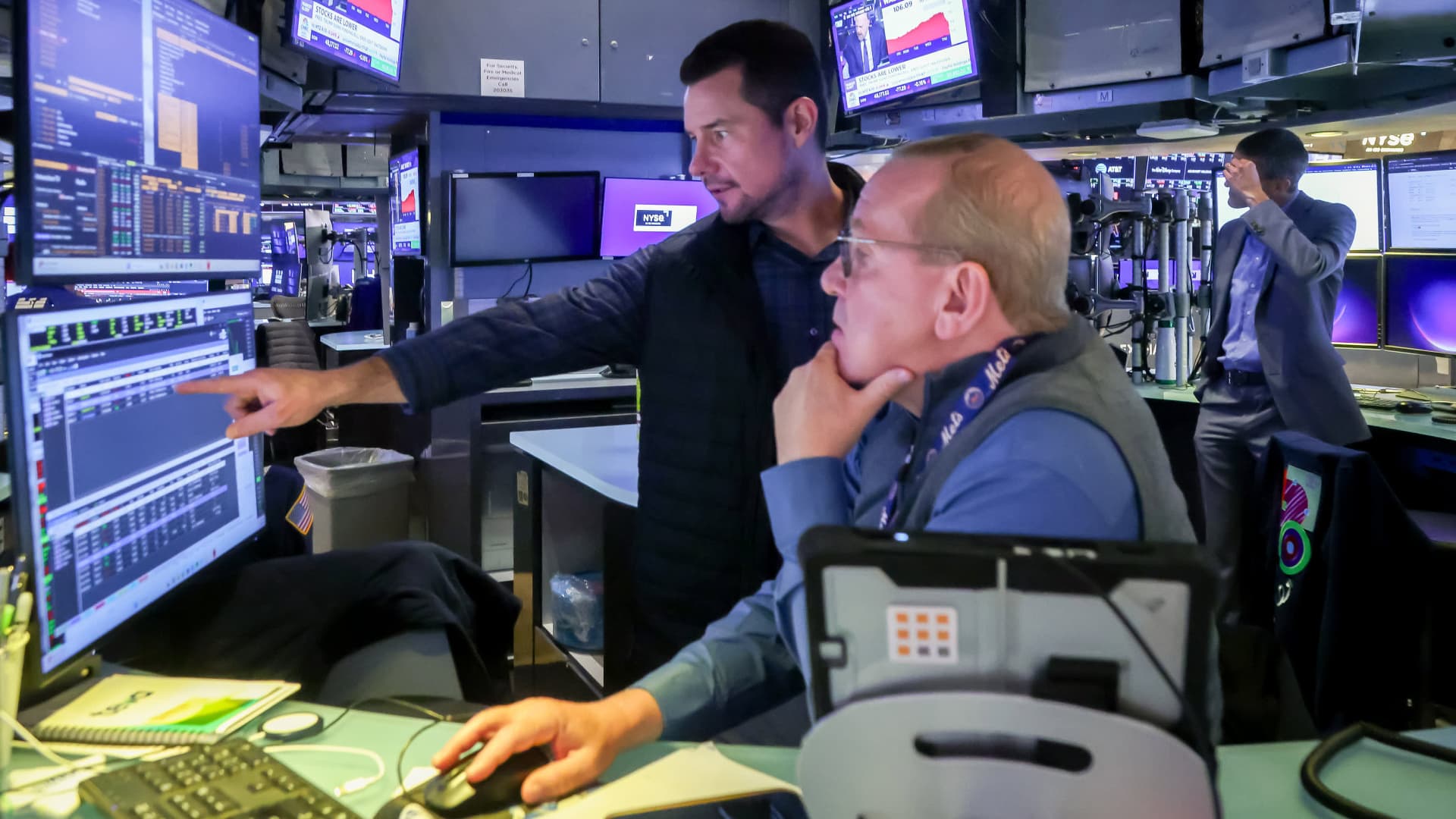
    Stocks with exposure to the artificial intelligence trade were the biggest drag on U.S. key benchmarks Wednesday stateside, after The Information reported Microsoft was cutting software sales quotas tied to artificial intelligence. 

    Other major tech names, including Nvidia and Broadcom, pulled the broad-based S&P 500 lower.

    Microsoft refuted the claims in the report, which led the stock to recover slightly in after-hours trading.

    — CNBC’s Sean Conlon and Pia Singh contributed to this report.

    Continue Reading

  • Salesforce CEO vies to overcome investors’ AI skepticism while touting company’s quarterly numbers

    Salesforce CEO vies to overcome investors’ AI skepticism while touting company’s quarterly numbers

    SAN FRANCISCO — After riding the artificial intelligence craze to new heights, business software maker Salesforce has been pummeled by a wave of investor skepticism that’s intensified the pressure on its persuasive CEO Marc Benioff to reverse the tide.

    Benioff, who helped spearhead the transition to cloud computing after founding Salesforce in 1999, got a chance to try to change the AI narrative late Wednesday with the release of his company’s latest quarterly results.

    The key numbers covering the August-October eclipsed the analyst projections that help steer the stock market, providing Benioff with some material to support his contention that Salesforce’s big bets on AI will yield a jackpot. The San Francisco-based company earned $2.1 billion, or $2.19 per share, a 37% increase from the same time last year while revenue rose 9% to nearly $10.9 billion. Salesforce also provided an outlook for the current quarter ending in January that exceeded analysts’ predictions.

    “We’re uniquely positioned for this new era,” Benioff boasted during a 25-minute address on an analyst conference call that sometimes sounded like an AI sermon that also featured comments about “wow” moments that customers experience when seeing the company’s technology.

    Salesforce’s shares initially surged by more than 5% after the results came out, but backtracked to a gain of 2% following Benioff’s presentation.

    It’s unclear if that modest momentum will be sustained in Thursday’s regular trading session because making more money than analysts anticipated isn’t necessarily enough to keep propelling a technology stock amid persisting doubts about whether the hundreds of billions of dollars being poured into the much-hyped technology will pay off.

    Nvidia, the dominant maker of the chips needed to power AI, put a dent in the wall of worry a couple weeks ago with a quarterly earnings report that soared far beyond analyst estimates and initially eased fears about a Big Tech bubble bursting.

    But the tranquility quickly evaporated, leaving Nvidia’s stock price slightly below where it was trading before the company’s stellar earnings report and 15% below its peak price reached in late October when the chipmaker became the first company to be valued at $5 trillion.

    The AI jitters have punished Salesforce even more severely. Before the earnings report was released, Salesforce’s market value had plunged by 35%, wiping out about $125 billion in shareholder wealth, since Salesforce’s stock price peaked at $369 a year ago.

    The downturn has happened even as Benioff has been doing his best to highlight AI’s potential benefits while calling upon the flair for salesmanship that he developed while become the become a chief evangelist behind the rise of software subscription services amid the ruins of the dot-com bust a quarter century ago.

    Benioff, who owns Time magazine in addition to his Salesforce job, also is among the Big Tech leaders who have forged ties with President Donald Trump this year while trying to persuade the administration to adopt AI-friendly policies to protect U.S. interests as China also works feverishly on the technology.

    Salesforce has been primarily focused on creating Ai agents that can automate more customer sales agents while spawning a digital labor force that will take over jobs that have traditionally been filled by people.

    In a sign that Benioff intends to practice what he preaches, Salesforce laid off 4,000 of its own customer support workers as its “Agentforce” technology took over more of the responsibilities.

    But the corporate customers that buy Salesforce’s services haven’t been embracing AI agents as quickly as investors initially thought, turning the company into a “poster child” for the doubts hanging over the technology, said Jay Woods, chief market strategist for investment banking firm Freedom Capital Markets.

    The second-guessing hasn’t dimmed Benioff’s AI exuberance – a passion that recently displayed in a resounding endorsement of Google’s latest version of the Gemini technology powering its AI suite.

    “We all know that the speed of innovation has exceeded the speed of customer adoption,” Benioff conceded while confidently predicting that dynamic is about to change dramatically as more companies and government agencies build AI services into their operations.

    Salesforce is projecting $60 billion in revenue for its fiscal year ending in January 2030 – a target that would require average annual increases of 10% from its forecasted sales of $41.5 billion for its current fiscal year. The company also just completed an $8 billion acquisition of another software maker, Informatica, that is building AI tools to manage corporate data.

    “We’re continuing to execute on the path to our $60 billion dream” Benioff said.

    Continue Reading