Category: 3. Business

  • Treasuries Rise on Weak US Jobs, Dollar Holds Loss: Markets Wrap

    Treasuries Rise on Weak US Jobs, Dollar Holds Loss: Markets Wrap

    (Bloomberg) — Treasuries rose across the curve as cash trading resumed, after private-sector data showed a cooling US jobs market, boosting bets on an interest-rate cut by the Federal Reserve.

    The yield on the 10-year fell four basis points to 4.08% after employment figures from ADP Research signaled US companies shed 11,250 jobs per week on average in the four weeks ended Oct. 25. Money markets also added to bets on Fed rate cuts, pricing roughly a 70% chance of a reduction next month, according to swaps tied to policy-meeting dates. Asian shares edged up, with most companies rising but technology firms declining.

    The federal government’s closure has elevated the importance of private data, as investors lacked key official indicators to gauge the strength of the American economy. The record US shutdown may end as soon as Wednesday after the Senate passed a temporary funding bill, buoying stocks as investors brace for a flood of delayed data once agencies reopen.

    “The biggest near-term catalyst would be a reopening of the government which would buttress current-quarter GDP forecasts but also may release more liquidity into the market, which typically is supportive of stocks,” said JPMorgan Market Intelligence team led by Andrew Tyler.

    The figures suggested the labor market slowed in the second half of October, compared with earlier in the month. ADP’s most recent monthly report, released last week, showed private-sector payrolls increased 42,000 in October after declining in the prior two months.

    The data come after an array of companies flagged plans to reduce headcount in recent weeks. A report from outplacement firm Challenger, Gray & Christmas Inc. showed employers announced the most job cuts for any October in more than two decades, spurring anxiety about the health of the labor market.

    A Bloomberg gauge of the dollar was flat early Wednesday after declining for five straight days. Gold traded above $4,100 an ounce.

    Earlier, the tech-heavy Nasdaq 100 closed lower with Nvidia Corp. sinking 3% after SoftBank Group Corp. said it sold its entire stake in the chipmaker to help bankroll artificial-intelligence investments. SoftBank plunged as much as 10% in Tokyo trading.

    Meanwhile, the reopening of the government now depends on the House, which plans to return to Washington to consider the spending package. It would keep most of the government open through Jan. 30 and some agencies through Sept. 30.

    If approved, the bill goes to President Donald Trump, who has already endorsed the legislation.

    Back in 2013, which was the last shutdown to affect the jobs report, the government reopened on October 17, and the September jobs report was released five days later, noted Jim Reid at Deutsche Bank.

    “So based on that timeline, we could get the September jobs report pretty quickly, not least because the original release was meant to be on Oct. 3, just a couple of days after the shutdown began,” he said. “Early next week is realistic.”

    The resumption of economic data releases could make the case for increased wagers on Fed rate cuts. Most economists surveyed by Bloomberg suggest that Fed officials will lower borrowing costs by a quarter-point at their Dec. 9-Dec. 10 meeting. But the central bank’s path remains foggy after Chair Jerome Powell last month said a cut is not a certainty, a sentiment since shared by others at the Fed.

    Corporate News:

    Advanced Micro Devices Inc., Nvidia Corp.’s nearest rival in AI chips, predicted accelerating sales growth over the next five years, driven by strong demand for its data center products. A group of investors led by Macquarie Group Ltd. is expected to acquire infrastructure services business Potters Industries from private equity firm TJC, in a deal valuing the company at approximately $1.1 billion. JD.com Inc. said orders surged nearly 60% during this year’s Singles’ Day event. South Korea’s POSCO Holdings Inc. will buy a 30% stake in Mineral Resources Ltd.’s lithium business in a deal worth $765 million. Sea Ltd.’s quarterly profit missed analysts’ estimates after the company boosted spending to battle competitors in Southeast Asia’s cutthroat e-commerce market. Some of the main moves in markets:

    Stocks

    S&P 500 futures were little changed as of 9:22 a.m. Tokyo time Hang Seng futures rose 0.4% Japan’s Topix rose 0.7% Australia’s S&P/ASX 200 rose 0.2% Euro Stoxx 50 futures rose 0.3% Currencies

    The Bloomberg Dollar Spot Index was little changed The euro was little changed at $1.1584 The Japanese yen was little changed at 154.10 per dollar The offshore yuan was little changed at 7.1211 per dollar The Australian dollar was little changed at $0.6529 Cryptocurrencies

    Bitcoin rose 0.5% to $103,087.95 Ether rose 0.3% to $3,427.51 Bonds

    The yield on 10-year Treasuries declined four basis points to 4.08% Japan’s 10-year yield was little changed at 1.690% Australia’s 10-year yield declined two basis points to 4.37% Commodities

    West Texas Intermediate crude fell 0.1% to $60.95 a barrel Spot gold rose 0.3% to $4,141.28 an ounce This story was produced with the assistance of Bloomberg Automation.

    –With assistance from Toby Alder.

    ©2025 Bloomberg L.P.

    Continue Reading

  • Stock market today: Live updates

    Stock market today: Live updates

    A trader works on the floor of the New York Stock Exchange.

    NYSE

    Stock futures were relatively flat Tuesday night following a session where investors sold off technology names and drove a rally in more risk-off parts of the market.

    Futures tied to the Dow Jones Industrial Average added 12 points points, or 0.02%. S&P futures were mostly flat, while Nasdaq 100 futures inched up 0.1%.

    Tuesday saw a tale of two markets emerge — the Dow Jones Industrial Average rallied more than 550 points to close at a record high, while the Nasdaq Composite slipped. The S&P 500 closed up higher, notching its third positive session in a row.

    Consumer stocks such as Walmart, Home Depot and McDonald’s propped up the 30-stock Dow on Tuesday as traders moved into parts of the market with lower valuations and less exposure to the artificial intelligence trade. The health care sector was the top-performing sector, driven by moves higher in names such as Eli Lilly and Johnson & Johnson.

    Darling AI stocks such as Nvidia swung lower on Tuesday, reflecting the uneasy sentiment among investors that tech valuations could be stretched after their recent surge. Talks of a stock market bubble have not dissipated either, but investors are showing more discernment between which tech giants appear to have a leg-up in the AI race.

    “When you have very few groups making new highs, very few stocks remaining above their 200-day moving average or 40-day moving average … it’s a very interesting rotation,” Craig Johnson, chief market technician at Piper Sandler, said Tuesday on CNBC’s “Power Lunch.” “What hasn’t been working is a place to go hide right now.”

    Investors also digested a new ADP report that showed private employers cut payrolls in October, adding to worries about labor market weakness. The report received greater focus since the record-setting U.S. government stoppage has halted many crucial economic releases. The U.S. government could reopen as soon as the end of this week. The Senate on Monday evening passed a spending bill that has since moved to the House of Representatives for a final vote.

    Continue Reading

  • Five takeaways from the release of a much-awaited crypto market structure bill

    Five takeaways from the release of a much-awaited crypto market structure bill

    The U.S. Capitol is shown the morning after the Senate passed legislation to reopen the federal government on Nov. 11, 2025 on Capitol Hill in Washington, DC.

    Win McNamee | Getty Images

    The Senate Agriculture Committee has released a draft of its portion of a much-awaited digital assets market structure bill — a critical step toward accelerating institutional and retail adoption of cryptocurrencies. 

    Unveiled on Monday by Agriculture Chair John Boozman, R-Ark., and Sen. Cory Booker, D-N.J., the bipartisan discussion draft lays the groundwork for creating guardrails for the crypto industry in the U.S. It also establishes guidelines for institutions that want to work with digital assets, from bitcoin and ether to tokenized financial instruments.

    “This is the most consequential roadmap for how an institution is going to integrate digital assets into their business,” Cody Carbone, CEO of crypto trade association Digital Chamber, told CNBC. “It’s like the best possible step-by-step of what type of compliance rules requirements they would need to follow to work with crypto.”

    Here are five key takeaways from the discussion draft.

    1. Grants favorable regulatory status to some cryptocurrencies

    The text classifies some of the largest digital assets by market capitalization such as bitcoin and ether as “digital commodities,” placing them under the Commodity Futures Trading Commission’s purview.  

    This provision removes a major blocker to digital asset adoption for institutional fiduciaries, Juan Leon, an analyst at crypto-focused asset manager Bitwise, told CNBC.

    “Compliance and risk departments will finally have a federal statute to point to,” Leon said. “This shifts the internal conversation … [and] it provides the legal certainty required to move assets into a formal, strategic allocation.”

    It will also create “a starkly bifurcated market” consisting of regulated and unregulated tokens, with the former class of assets seeing “a massive influx of institutional capital, deep liquidity and a robust derivatives ecosystem.”

    2. Requires crypto firms to segregate funds and manage conflicts of interest

    The draft calls for crypto companies to “establish governance, personnel, and financial resource separation among affiliated entities that perform distinct regulated functions.”

    Bitwise’s Leon interprets the provision as a challenge to the “all-in-one” business model that is common among crypto exchanges. According to those models, an exchange, broker, custodian, and proprietary trading desk are all wrapped up into one entity. 

    In other words, digital asset firms could be required to keep their various businesses separated like traditional financial companies, according to Leon. The change would serve as “a foundational pillar for institutional adoption.”

    3. Gives the CFTC more power to regulate digital assets 

    The text gives more power to the CFTC, empowering it to work in tandem with the Securities and Exchange Commission to issue joint rulemaking on crypto-related matters.

    “There’s a lot more power or authority delegated to the CFTC to have jurisdiction over this industry,” Carbone said. 

    The shift comes after the SEC for years served as the main regulator of digital assets, after it edged out the CFTC to gain authority over the industry. 

    4. Allows the CFTC to collect fees

    The draft calls for regulated entities to pay fees to the CFTC. Those fees would go toward registering digital commodity exchanges, brokers and dealers, in addition to conducting oversight of regulated entities and carrying out education and outreach. 

    5. Establishes listing standards for tokens

    The text calls for crypto exchanges to only permit trading of digital commodities that are “not readily susceptible to manipulation.”

    It’s a provision that could reduce the number of “rug pulls” and other scams that are still common in some parts of the crypto industry, with the goal of establishing standards and building confidence in the market.

    What’s next?

    The Senate Agriculture Committee’s discussion draft is far from final, but it does offer critical insights into the direction of efforts to pass crypto-friendly regulations in the U.S., according to Carbone.

    “It’s not final, it’s not done, but this gives a good sense of where Congress is going and what the final rules may be,” Carbone said. 

    The committee will likely spend the next few weeks getting feedback on their draft, meaning it may be “almost impossible to get [a final version of this part of the bill] done by the end of the year,” he added.

    However, that period will give lawmakers time to offer more concrete guidance on several issues that are bracketed – or not yet finalized – in the discussion draft. Those include provisions on anti-money laundering rules and regulations specific to decentralized finance players.

    Several crypto players plan to work in tandem with lawmakers to help iron out those details, among others. 

    “We’ve long said crypto is a bipartisan issue, and this draft from Chairman Boozman and Senator Booker reflects that,” Moonpay President Keith Grossman told CNBC. “It’s critical that legislation distinguishes between centralized intermediaries and decentralized systems, and we look forward to working with the Committee to get it right.”

    The discussion draft is only one piece of larger legislative efforts to overhaul regulations for the crypto industry, according to Carbone. Ultimately, the text will be combined with the Senate Banking Committee’s draft on the digital assets market structure in a bid to create one comprehensive bill.

    And although lawmakers are nowhere near the finish line in that process, crypto firms are finding other ways to work with regulators and other authorities to meaningfully advance their industry, Grayscale Investments Chief Legal Officer Craig Salm told CNBC.

    “In the absence of comprehensive legislation, we’ve still seen meaningful progress on the regulatory front,” Salm said, adding that the SEC, Internal Revenue Service and Treasury Department have recently provided guidance around staking in crypto exchange-traded products. “That said, thoughtful legislation will be critical to solidifying the foundation of the digital asset industry in the U.S. and unlocking even greater value for investors and consumers.”

    Continue Reading

  • Australian supermarket wheat crackers taste test: ‘All the reviewers knew which one was the real deal’ | Australian food and drink

    Australian supermarket wheat crackers taste test: ‘All the reviewers knew which one was the real deal’ | Australian food and drink

    I’ve been wanting to write this article for over a year but I’ve been too intimidated and confused to start. There are several hundred supermarket products that could be called a cracker. Imagine a taste test with 100 versions of the same thing. Do I have the stomach space or mental bandwidth to process that much? Otherwise, how do I decide what’s in or out? Even if I did, how do I rule what is a cracker or not? How do you determine the criteria for tasting something rarely eaten on its own? Do you rate the crackers for deliciousness or compatibility? Are those two things even that different?

    Then there’s the anxiety of spending several days agonising over all that, and conducting a taste test only to arrive at the conclusion that Jatz are great. Do people want to read an article about why Sir Donald Bradman is better than whoever the second-best-ever cricketer is?

    Instead of answering all those questions, I could just have a lovely afternoon making my way through 17 kinds of chocolate or many iced coffees. But last week, my curiosity overcame my anxiety. I sorted several hundred crackers into a complicated family tree-like categorisation system, then sorted that based on the following criteria: size and structure designed for dips, cheese and platters; unflavoured; and wheat-based. This left me with 19 products, a mix of classic, water and wafer crackers.

    Rice crackers, crackers fit for stacking ingredients (the Vita-Weat and Cruskits category), crackers designed for snacking without toppings (the Shapes zone) and gluten-free options will have to wait for future taste tests.

    Nicholas Jordan and friends tasted classic, water and wafer crackers – 19 products in all. Composite: Rémi Chauvin
    ‘The best cracker is both enjoyable to eat on its own and paired with other things’. Photograph: Rémi Chauvin/The Guardian

    I did the blind taste test with six others. We ranked every cracker on appearance, taste and texture. Appearance made up a small percentage of the final score, but texture and taste were weighted evenly.

    When the taste test finished, I had five thoughts:

    • Jatz are, predictably, awesome.

    • So are the products trying to be like Jatz.

    • Water crackers are the opposite of awesome.

    • The best cracker is both enjoyable to eat on its own and paired with other things.

    • What the hell are wafer crackers?

    The best overall

    Arnott’s Jatz Original, 225g, $4 ($1.78 per 100g), available at major supermarkets

    Score: 8.5/10

    There are several crackers that look, smell and taste like Jatz but all the reviewers knew which one was the real deal, and almost everyone gave it the highest score of the day. I don’t think I’ve ever met someone who doesn’t love them (or their southern equivalent, Savoy). So I don’t think it’s a good use of anyone’s time to read or write a paragraph on what they taste like. Instead, I want to address a suspicion I have: that the anxious social organisers among us are hesitant to lay them out on a picnic platter or dinner party. Will they pair with the Époisses de Bourgogne? Do they match the Arita ware? Do they fit in with my aspirational middle-class status? Maybe ask this instead: would you deny your most charismatic friend a wedding invite because their only suit doesn’t match the Pinterest board? Give yourself and your loved ones what they want.

    The best value

    Damora Eton Original Cracker Biscuits, 225g, $1.49 ($0.66 per 100g), available at Aldi

    Score: 8/10

    If both Abba and their tribute band Bjorn Again came to Australia, would you pay $178 to see the original or $66 for something almost as good? Like any great piece of art, Jatz has imitators at a cheaper price – this and Woolworths Snapz Crackers. The Woolworths version tastes like a dialled-down, drier version of the original (it’s lower in fat and salt) – a cover band without the sequined jumpsuits. But the Aldi version is, according to the reviewers, as good or better than the original. Choosing between this and Jatz depends on your budget, brand loyalty and how much heft you want in a cracker (this one is a little denser and crunchier).

    The best cracker for a fancy dinner party

    La Panzanella Mini Artisan Crackers, 85g, $4.99 ($5.87 per 100g), available at select grocers

    Score: 6.5/10

    These crackers didn’t score the highest on appearance – Ritz, Jatz and other recognisable crackers scored better. But I’ve picked out this category because it has a slightly different criteria: cultural capital, which in any middle-class world is hard to gain from anything broadly recognisable. And in that environment, a cracker that looks and tastes bespoke will flourish – look at the jagged edge, the uneven size, the wholemeal colour. Uneven seasoning (some parts bland, some popping with salt crystals) and an oily finish make these inappropriate for solo snacking, but the snap and neutral wheaty flavour will suit your goat’s cheese or quince jam.

    The rest

    Damora Crisps Sea Salt, 150g, $2.99 ($1.99 per 100g), available at Aldi

    Score: 7/10

    A cracker shaped like a country, cut with potato and cornflour, salted more generously than most packets of chips and labelled with a giant emboldened “crisps” is pushing the boundaries of what qualifies as a cracker. Despite how thin it is, it’s solid enough to scoop guacamole and has a good snap. Even if it isn’t a cracker, it does everything you need a cracker to do. You could say that about a Pringle too, but they won’t hold up to the curatorial rigours of the picnic aesthetic, unlike these “crisps”. Like Pringles, these also fail to pair well with Persian fetta, or anything else salty enough to kill a small mammal.

    Ritz Original Crackers, 227g, $3.50 ($1.54 per 100g), available at major supermarkets

    Score: 7/10

    Ritz is unlike any other cracker on the market, and anything that stands out in a field with such homogeneity is going to be divisive. The haters scored it four or five out of 10 and described it as oily, crumbly and “like badly made junk food”. One reviewer wrote: “Way too fleshy, it dissolves in your mouth and sticks to your teeth.” The fans scored it nine out of 10. Instead of oily, they said it was buttery; instead of crumbly, melt-in-your-mouth. You will have to decide which side you’re on.

    Woolworths Oven Baked Sea Salt Crackers, 185g, $2.20 ($1.19 per 100g), available at Woolworths

    Score: 6.5/10

    “Cute frilly edges, my grandma might serve this to me on a doily,” one reviewer wrote. In this case, grandma may have been storing them in the tin a little too long, giving them an oddly stale texture. This cracker has a decent snap but, compared with its peers, it’s far softer to bite and quickly becomes pasty in your mouth. I don’t think they’re literally stale, I think the texture is a result of how much oil they contain (per gram, this is the second-fattiest cracker after Ritz). There were more compliments about the taste, which some described as cheesy – unusual for a cracker made of wheat. My guess is that’s the result of deactivated yeast or “natural flavouring”. But the reason I won’t be buying these is the oddly large size. If you do, be prepared to inform picnic guests that double dipping is OK, or get ready to down a colossal hunk of cheese in one go.

    Kurrajong Kitchen Oaklees Originals, 120g, $3 ($2.50 per 100g), available at Coles

    Score: 6/10

    These are sweet, mealy, malty and toasty, but all of it pushed a little too far, like eating cereal that has been flattened by a steamroller. Do I want to eat that as a snack? No. Do I want to smother it with hummus? Also no. It might be OK with a soft goat’s cheese or something very sharp, but when I’m laying out crackers for a social engagement I don’t want guests to have to troubleshoot their cracker and dip pairings. You might though, and if you do, you should be looking at the flavoured section of the cracker aisle, a wild land with figs, olives, unusual textures and opportunities for platter creativity.

    Wafer crackers

    Average price: $2.50 per 100g

    Average score: 6.5/10

    We tried four wafer crackers and they all scored six or six-and-a-half out of 10. If I hadn’t eaten them right after each other, I don’t think I would have been able to tell the difference. They all have a useful and pleasing rice-cracker-like brittleness, but they all go a bit gluey after a few chews, like a wheat-flavoured Roll-Up. I was shocked to find they all included cheese powder, a fact none of the reviewers picked up when tasting them. Ultimately, they’re serviceable but boring, a cracker that would be served at the Christmas parties of local government organisations. As they’re more expensive per gram than Jatz or Eton, I will never buy them.

    Water crackers

    Average price: $1.15 per 100g

    Average score: 3.5/10

    I don’t think there’s any point in comparing water crackers. Sure, some are worse than others, but as you can see from the score table below, the best water crackers are easily worse than all other crackers. The first red flag is the name, a comic advertisement of how boring the incoming experience is. Boredom is fine, you can put baba ganoush on that, but the real kicker is the irony: this is the least wet experience I’ve had in any taste test, and that includes eating 18 tahinis in one sitting. If I was a dentist, I’d use them as saliva ejectors. I’m surprised I hadn’t written off water crackers sooner. Given their absurdly low prices, I can forgive the oral dehydration but I can’t excuse buying them while knowing I can get a pack of Eton for cheaper. If there is ever a global wheat shortage, water crackers should be the first thing to go.

    Table of crackers, ranked by score, then price and where they’re available to purchase.

    Continue Reading

  • Household financial disparity grows in the aftermath of the COVID-19 pandemic, CSI data shows

    Household financial disparity grows in the aftermath of the COVID-19 pandemic, CSI data shows

    Consumer survey data from S&P Global highlight a wide and
    growing divergence between the financial wellbeing of the lowest
    income and wealthiest households in the UK.

    Measuring wellbeing

    The Consumer Sentiment Index survey tracks key metrics among UK
    households on a monthly basis, with the data series dating back to
    early-2009. The most recent monthly datasets have shown some
    encouraging signs of recovery, with the headline index reaching one
    of its highest levels recorded in the survey. However, a closer
    examination of the underlying data reveals markedly divergent
    trends by income group, particularly since the pandemic and
    throughout the ongoing cost of living crisis.

    One of the questions included in the CSI questionnaire asks
    respondents to compare their household’s financial situation to
    that of the previous month. While the tracker has generally been
    relatively elevated in recent months compared to the survey’s
    long-run average, further analysis reveals significant divergences
    in financial wellbeing based on household income levels.

    The data breaks downs households into five different income
    tiers:

    • less than £15,000 per year

    • £15,001 to £23,000 per year

    • £23,001 to £34,500 per year

    • £34,501 to £57,750 per year

    • £57,751 or more per year.

    Individuals in the higher income tiers generally report more
    positive responses than their counterparts in all other income
    brackets, but the disparity between the highest income tier and the
    other brackets has widened in recent years.

    This note will specifically examine the increasing gap between
    the highest and lowest income brackets.

    Growing divergence between higher and lower income
    households since the pandemic

    The COVID-19 pandemic introduced substantial shocks to
    households’ financial wellbeing in the early months. All income
    brackets reported a marked deterioration in their financial
    situations in 2020, a trend that not only persisted but deepened
    over the following years amid the cost-of-living crisis with the
    notable exception of the highest income bracket, where the
    experience has been more mixed.

    Since the pandemic, households have faced mounting pressure from
    rising costs of essentials such as food, energy, and housing.
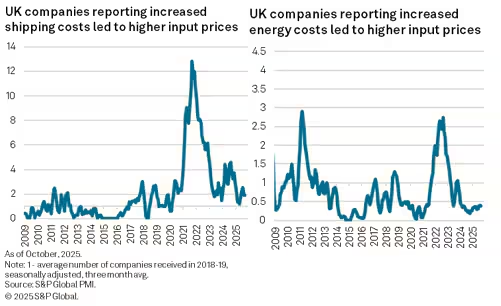
    Energy prices, in particular, have undergone extreme fluctuations,
    largely driven by the Ukraine-Russia conflict. Furthermore, supply
    chain disruptions, including shipping challenges in the Red Sea,
    have compounded shortages and elevated costs for essential
    goods.

    The repercussions of soaring energy costs and supply-side
    challenges on input prices are captured in S&P Global Panel
    Comments Trackers data, which provide qualitative insights from PMI
    survey contributors around the globe.

    The peak of this inflation crisis in the UK was experienced in
    late 2022, when inflation soared to a 41-year high of 11.1%,
    significantly surpassing the Bank of England’s target of 2%. This
    period coincided with households reporting the most severe decline
    in monthly financial wellbeing on record in October 2022, with the
    seasonally adjusted headline index plunging to 26.9.

    Notably, the gap between the highest and lowest earners at this
    time was relatively narrow compared to historical averages.

    The central bank reacted by tightening its monetary policy with
    a series of interest rate hikes. However, as inflation began to
    subside, this shift coincided with an expanding divide between the
    highest and lowest earning households. Indeed, high-earning
    households have consistently outperformed all other income brackets
    during this period.

    Wealthy households bounce back, but lower income
    households struggle

    As a result, differences in financial wellbeing among households
    based on income have become more pronounced in recent years. The
    chasm between the highest and lowest earners reached its zenith in
    June 2024, just before the General Election. At that juncture, the
    Bank of England’s policy rate had risen to a high of 5.25%,
    occurring just one month prior to the central bank’s first rate
    cut, which was followed by a series of further reductions.

    Higher income households have demonstrated a more robust
    recovery from the economic repercussions of the pandemic and the
    ongoing cost of living crisis, as illustrated by the chart below,
    which plots the shifts in financial wellbeing among the highest and
    lowest income tiers since 2009, based on yearly averages. For the
    years 2024 and 2025 (data available up to October), the highest
    earning households have reported noteworthy improvements in their
    financial circumstances. This trend underscores the resilience of
    affluent households as they navigate the economic landscape,
    achieving performance levels not previously seen in the series’
    history.

    Meanwhile, lower income households displayed some signs of
    recovery in 2023 and 2024; however, they are experiencing greater
    financial pressures again in 2025.

    Outlook

    The CSI data suggest that the disparity between higher and lower
    earning households is set to endure, with affluent households
    displaying relatively higher optimism regarding their financial
    wellbeing outlook. In contrast, lower income households are bracing
    for further declines in their financial health.

    The upcoming Autumn Budget will be pivotal in shaping the
    financial landscape for households in the year ahead. Adjustments
    to the National Minimum Wage and National Insurance contributions,
    alongside evolving tax implications, are fostering an environment
    of uncertainty for both consumers and businesses.

    Moreover, it will be crucial to assess the measures the
    Chancellor may implement to support households, particularly as the
    winter months loom.

    Access the October CSI press release
    here.

    The next CSI release is scheduled for 17th
    November
    .

    Maryam Baluch, Economist, S&P Global Market
    Intelligence

    Tel: +44 1344 327 213

    maryam.baluch@spglobal.com

    © 2025, S&P Global. All rights reserved. Reproduction in whole
    or in part without permission is prohibited.


    Purchasing Managers’ Index™ (PMI®) data are compiled by S&P Global for more than 40 economies worldwide. The monthly data are derived from surveys of senior executives at private sector companies, and are available only via subscription. The PMI dataset features a headline number, which indicates the overall health of an economy, and sub-indices, which provide insights into other key economic drivers such as GDP, inflation, exports, capacity utilization, employment and inventories. The PMI data are used by financial and corporate professionals to better understand where economies and markets are headed, and to uncover opportunities.

    Learn more about PMI data

    Request a demo


    This article was published by S&P Global Market Intelligence and not by S&P Global Ratings, which is a separately managed division of S&P Global.

    Continue Reading

  • Adecoagro S.A.:Adjusted EBITDA reached $115.1 million in 3Q25. All-time crushing record and switch to ethanol maximization. Challenging global price scenario continues.

    LUXEMBOURG, Nov. 11, 2025 /PRNewswire/ — Adecoagro S.A. (NYSE: AGRO, Bloomberg: AGRO US, Reuters: AGRO.K), a leading sustainable production company in South America, announced today its results for the third quarter ended September 30, 2025. The financial information contained in this press release is based on consolidated interim financial statements presented in US dollars and prepared in accordance with International Financial Reporting Standards (IFRS) except for Non – IFRS measures. Please refer to page 22 for a definition and reconciliation to IFRS of the Non – IFRS measures used in this earnings release.

    Main highlights for the period:

    • Higher Adjusted EBITDA in 3Q25 was led by the Sugar, Ethanol & Energy business. In 9M25, the decline was explained by lower prices, higher costs and a mixed performance in yields.
    • Higher expansion capex was driven by the $96.0 million advance payment to purchase Nutrien’s stake in Profertil. Excluding this, expansion capex increased by $5.7 million in 3Q25 and $13.6 million in 9M25.
    • Net Debt/LTM Adj. EBITDA stood at 2.8x on lower consolidated results and the aforementioned payment for Profertil. We are currently working on an Action Plan to reduce our cost structure while reviewing our capital allocation strategy.

    Sugar, Ethanol & Energy business:

    • Adjusted EBITDA amounted to $120.5 million in 3Q25, 20.3% higher year-over-year, whereas year-to-date it reached $218.4 million, 15.6% lower compared to 9M24.
      (+) Switched to ethanol max scenario (58% in 3Q25 / 55% in 9M25) on greater margins than sugar.
      (+) Year-over-year gains in biological assets on greater expected productivity and lower costs.
      (+/-) All-time crushing record in 3Q25 (4.9 million tons; 20.4% increase versus 3Q24). Catching up our harvesting pace with 9.8 million tons crushed year-to-date.
      (+/-) In-line production cost in 3Q25 thanks to higher dilution on record crushing. Year-to-date, cost of production stood at 8.3 cts/lb (versus 7.8 cts/lb in 9M24) on lower TRS equivalent produced, and therefore lower cost dilution.
      (-) Lower net sales in both 3Q25 and 9M25 due to lower selling volumes and prices of sugar, despite the recovery in ethanol prices.

    Farming business:

    • Adjusted EBITDA reached $1.5 million in 3Q25 and $19.2 million in 9M25, $15.9 million and $80.0 million lower year-over-year, respectively. Excluding the sale of La Pecuaria farm in April 2024, Adjusted EBITDA was down $65.0 million on a year-to-date basis.
      (+) Higher volumes sold of our Dairy products and Crops.
      (+/-) Record production in our Rice operations but selling at a slower pace.
      (-) Lower prices for crops, rice and dairy products.
      (-) Year-over-year losses in the mark-to-market of our biological asset for the 2024/25 harvest season.
      (-) Higher costs in U.S. dollar terms for the 2024/25 harvest season.

    Remarks

    Adecoagro to Acquire Best in Class Urea Producer

    • In September 2025, Adecoagro announced an agreement to acquire Nutrien Ltd.’s 50% interest in Profertil S.A., South America’s largest producer of granular urea. The remaining 50% stake is held by YPF S.A., Argentina’s largest oil and gas producer. The acquisition will be executed through a 80%-20% partnership between Adecoagro and Asociación de Cooperativas Argentinas (“ACA”). The total purchase price for Nutrien’s shares is ~$600 million. An initial Down Payment of $120 million was made upon signing the agreement, out of which the Company contributed $96 million. Closing is expected before year-end, subject to customary conditions and YPF’s 90-day right of first refusal.
    • This acquisition represents a transformational step in Adecoagro’s strategy to expand its agro-industrial platform and further diversify its revenue base. Profertil is one of the lowest cost producers of urea and ammonia globally, with access to competitively priced natural gas and located in a net importing region. The company is led by an experienced management with a proven track record, has fully dollarized revenues and consistent cash generation—averaging $390 million in EBITDA per year between 2020 and 2024—.

    2025 Shareholder Distribution

    • On November 19, we will pay the second $17.5 million cash dividend ($0.17484886 per share) to shareholders of record as of November 3, completing a total annual cash dividend of $35.0 million. During the year we also invested $10.2 million in repurchasing 1.1% of the company’s equity (1.1 million shares at an average price of $9.65 per share). With a total of $45.2 million distributed, the Company concludes its 2025 Shareholder Distribution Program.

    Independent Farmland Appraisal Report

    • As of September 30, 2025, Cushman & Wakefield updated its independent appraisal of Adecoagro’s farmland which consists of 210,371 hectares valued at $714.8 million (4.7% higher year-over-year). The Company’s equity book value, net of non-controlling interests, is $13.7 per share.

    Resignation of Mr. Daniel González as Board Member

    • Mr. Daniel González has resigned from the Company’s Board of Directors, effective November 3, 2025. He has been a member of the Company’s Board since 2014, and during his tenure contributed meaningfully to the Company’s growth and development. We thank Daniel for his commitment and valuable service, which have helped make Adecoagro a better company.

    Non-Gaap Financial Measures:  For a full reconciliation of non-gaap financial measures please refer to page 22 of our 3Q25 Earnings Release found on Adecoagro’s website (ir.adecoagro.com)

    Forward-Looking Statements:  This press release contains forward-looking statements that are based on our current expectations, assumptions, estimates and projections about us and our industry. These forward-looking statements can be identified by words or phrases such as “anticipate,” “forecast”, “believe,” “continue,” “estimate,” “expect,” “intend,” “is/are likely to,” “may,” “plan,” “should,” “would,” or other similar expressions.

    The forward-looking statements included in this press release relate to, among others: (i) our business prospects and future results of operations; (ii) weather and other natural phenomena; (iii) developments in, or changes to, the laws, regulations and governmental policies governing our business, including limitations on ownership of farmland by foreign entities in certain jurisdictions in which we operate, environmental laws and regulations; (iv) the implementation of our business strategy; (v) the correlation between petroleum, ethanol and sugar prices; (vi) our plans relating to acquisitions (including our potential purchase of Profertil), joint ventures, strategic alliances or divestitures, and to consolidate our position in different businesses; (vii) the efficiencies, cost savings and competitive advantages resulting from acquisitions; (viii) the implementation of our financing strategy, capital expenditure plan and expected shareholder distributions; (ix) the maintenance of our relationships with customers; (x) the competitive nature of the industries in which we operate; (xi) the cost and availability of financing; (xii) future demand for the commodities we produce; (xiii) international prices for commodities; (xiv) the condition of our land holdings; (xv) the development of the logistics and infrastructure for transportation of our products in the countries where we operate; (xvi) the performance of the South American and world economies; and (xvii) the relative value of the Brazilian Reais, the Argentine Peso, and the Uruguayan Peso compared to other currencies.

    These forward-looking statements involve various risks and uncertainties. Although we believe that our expectations expressed in these forward-looking statements are reasonable, our expectations may turn out to be incorrect. Our actual results could be materially different from our expectations. In light of the risks and uncertainties described above, the estimates and forward-looking statements discussed in this press release might not occur, and our future results and our performance may differ materially from those expressed in these forward-looking statements due to, inclusive, but not limited to, the factors mentioned above. Because of these uncertainties, you should not make any investment decision based on these estimates and forward-looking statements.

    The forward-looking statements made in this press release relate only to events or information as of the date on which the statements are made in this press release. We undertake no obligation to update any forward-looking statements to reflect events or circumstances after the date on which the statements are made or to reflect the occurrence of unanticipated events.

    To read the full 3Q25 earnings release, please access ir.adecoagro.com. A conference call to discuss 3Q25 results will be held on November 12, 2025, with a live webcast through the internet:

    Conference Call
    November 12, 2025
    10 a.m. US EST
    12 p.m. Buenos Aires
    12 p.m. São Paulo
    4 p.m. Luxembourg
    To participate, please register at the link

    Investor Relations Department
    Emilio Gnecco
    CFO
    Victoria Cabello
    IRO
    Email: [email protected] 

    About Adecoagro:
    Adecoagro is a leading sustainable production company in South America. Adecoagro owns 210.4 thousand hectares of farmland and several industrial facilities spread across the most productive regions of Argentina, Brazil and Uruguay, where it produces over 3.1 million tons of agricultural products and over 1 million MWh of renewable electricity.

    SOURCE Adecoagro S.A.

    Continue Reading

  • Asian Stocks Look Higher as US Shutdown Nears End: Markets Wrap – Bloomberg.com

    1. Asian Stocks Look Higher as US Shutdown Nears End: Markets Wrap  Bloomberg.com
    2. Stocks rise, dollar dips with focus on labor market, US government reopening  Reuters
    3. Stock Rally Falters as Nvidia Sinks on Stake Sale: Markets Wrap  Bloomberg.com
    4. Senate approves bill to end shutdown; CoreWeave reports – what’s moving markets  Investing.com
    5. Tech, the lone cloud on sunny Wall Street  TradingView

    Continue Reading

  • Australia’s MinRes to sell 30% lithium JV stake to POSCO for $765 mln

    Australia’s MinRes to sell 30% lithium JV stake to POSCO for $765 mln

    Nov 12 (Reuters) – Australia’s Mineral Resources (MIN.AX), opens new tab will sell a 30% stake in its operational lithium business to South Korea’s POSCO Holdings (005490.KS), opens new tab for $765 million after placing it under a new joint venture, the miner said on Wednesday.

    The new entity will hold MinRes’ 50% ownership in the Wodgina and Mt Marion lithium mines, giving POSCO an indirect 15% interest in each of the projects.

    Sign up here.

    MinRes will remain the mines’ operator under its existing agreements with the respective partners.

    POSCO will receive spodumene concentrate in proportion to its 30% interest, supporting its plans for new downstream processing facilities.

    MinRes said the partnership builds on their existing Onslow Iron JV and will help meet rising demand for Australian lithium.

    The Wodgina and Mt Marion mines are among the most significant in Western Australia. Wodgina, one of the world’s largest hard-rock lithium deposits, is operated in partnership with Albemarle (ALB.N), opens new tab. China’s Ganfeng Lithium (002460.SZ), opens new tab is the partner for Mt Marion.

    The deal, approved by both boards, is subject to regulatory clearances including Australia’s Foreign Investment Review Board.

    Reporting by Rajasik Mukherjee; Editing by Sriraj Kalluvila

    Our Standards: The Thomson Reuters Trust Principles., opens new tab

    Continue Reading

  • Inside the Discovery That Changed CML Treatment Forever with Jorge Cortes, MD

    Inside the Discovery That Changed CML Treatment Forever with Jorge Cortes, MD

    When imatinib (Gleevec; Novartis), the first-ever tyrosine kinase inhibitor, made its debut in chronic myelogenous leukemia (CML), it revolutionized the treatment of a disease with a once-dismal prognosis.1

    Prior to its 2001 approval, CML therapies were often harsh, invasive, and ineffective.1 Now, 25 years later, current studies continue to align with previous research associating imatinib with major cytogenic responses,2 and targeted therapies have become cornerstones of treatment in a range of tumor types.3

    Imatinib was first used to treat patients during a clinical trial in 1998. Lead researchers in the earliest studies were Brian J. Druker, MD; Stephen G. O’Brien, MD; Jorge Cortes, MD; and Jerald Radich, MD. The American Journal of Managed Care® had the pleasure of speaking with Cortes, discussing the history and evolution of imatinib in the CML treatment paradigm.

    Patients with CML, unlike patients with acute lymphoblastic leukemia, are likely to have a longer life expectancy with and without treatment. Those with CML can still have a life expectancy of 3 to 5 years after diagnosis without treatment, but with treatment, their life expectancy is closer to the national average.4

    “I still remember Dr. Talpaz coming out of rooms and saying, ‘Wow, this thing works.’ He had this expression of wonder at the big change that it was representing… When the new study started…patients came to the study, but they wanted to get imatinib,” Cortes said.

    Development of imatinib began in the early 1990s under Druker at Oregon Health and Science University.1 Druker aimed to find a treatment for CML, and with the help of Nicholas Lyndon, MD, they identified a drug that was able to kill CML cells efficiently.1

    The phase 1 clinical trial of imatinib in 1998 was partially funded by the National Cancer Institute. The drug was then FDA-approved in 2001 to treat patients with CML. Of the patients in the original trial, 5 years later, 98% of them were still in remission.

    “[But] we’re not done [yet]. Patients are still looking for a better quality of life, for being able to stop therapy and all of that. We’ve made tremendous progress, and… we want to be optimistic, but we want to still always be careful and cautious and respect what cancer can do,” Cortes said.

    Listen above or on one of these podcast services:

    iTunes
    TuneIn
    Stitcher
    Spotify

    References

    1. How Gleevec transformed leukemia treatment. National Cancer Institute. April 11, 2018. Accessed November 10, 2025. https://www.cancer.gov/research/progress/discovery/gleevec#:~:text=NCI-supported%20research%20led%20to,evidence%20to%20support%20this%20hypothesis

    2. Druker BJ, O’Brien SG, Cortes J, Radich J; Chronic myelogenous leukemia. Hematology Am Soc Hematol Educ Program. 2002 (1):111–135. doi:10.1182/asheducation-2002.1.111

    3. Chronic myeloid leukemia (CML) research. Blood Cancer United. Accessed November 10, 2025. https://bloodcancerunited.org/research/blood-cancer-research-development-progress/leukemia/chronic-myeloid-leukemia-cml

    4. Targeted therapy for cancer. National Cancer Institute. Updated May 31, 2022. Accessed November 11, 2025. https://www.cancer.gov/about-cancer/treatment/types/targeted-therapies

    5. Faiman B. The impact of federal funding cuts on research, practice, and patient care. J Adv Pract Oncol. 2025;16(4):124-125. doi:10.6004/jadpro.2025.16.4.1

    Continue Reading

  • Great-West Lifeco, parent company to Canada Life U.K., Launches Keyridge Asset Management in support of UK Expansion

    Great-West Lifeco, parent company to Canada Life U.K., Launches Keyridge Asset Management in support of UK Expansion

    London, UK, November 11, 2025 — Great-West Lifeco Inc. (“Lifeco”) (TSX: GWO), an international financial services holding company whose brands Canada Life, Irish Life, and Empower collectively include CAD$3.3 trillion in client assets* today unveiled Keyridge Asset Management, the new global brand for its European Asset Management businesses. This integration enhances brand strength, broadens product offerings, and creates a European investment hub to support third-party distribution growth.

    With over GBP135 billion in combined assets under management*, Keyridge is primed for ambitious expansion in the UK. The firm already boasts a proven track record in delivering flexible, tailored strategies to meet evolving client needs, with a distinguished history of growth and excellent service for customers.

    The launch of Keyridge will underscore Lifeco’s deepening commitment to clients and long-term growth in one of the world’s most dynamic asset management markets, by combining the European asset management businesses of Canada Life Asset Management, Setanta Asset Managers and Irish Life Investment Managers to create a new force in the UK market.

    The move enhances the combined firms’ capacity and capability to deliver ever more innovative and effective investment solutions to clients as well as to a broader audience in a key growth market.  This will build on the firm’s success which has led to it being recognised as a market-leading provider of multi-asset solutions, fundamental equities and systematic quant and bespoke indexation.  Top-quartile performance and global consultant ratings have seen AUM triple in the past decade. 

    The ILIM and Setanta brands will continue to operate in Ireland, while CLAM will remain active in the UK, managing general account assets for Lifeco’s companies and partnering to deliver fixed interest fund management solutions to clients both in the UK and internationally. 

    Keyridge is powered by a 300-strong global team, led by Chief Executive Patrick Burke, and the firm’s ongoing investment in, and additional recruitment of, well known industry experts reflect its commitment to expanding Lifeco’s asset management presence in the UK market.  Keyridge’s independently rated operational platform sets it apart, enabling seamless integration across strategies and delivering outstanding execution for wealth advisers and their clients. 

    “Launching Keyridge in the UK reflects both our confidence in this market and our commitment to serving clients in one of the world’s most influential financial centres,” said Patrick Burke, CEO, Keyridge Asset Management. “Keyridge will provide UK wealth advisers and customers with the focus and expertise of our specialist investment management teams, combined with the scale, support and efficiency that goes with being part of a CAD$3 trillion global financial services group. Our ability to connect the full breadth of our investment expertise with a highly adaptable platform and partnership-driven culture means we can deliver solutions that truly align with our clients’ priorities.” 

    “Today’s announcement is a clear demonstration of our ambition to build a truly global asset management platform,” said Lindsey Rix-Broom, CEO Europe, Great-West Lifeco. “By bringing together the strengths of ILIM, Setanta, and Canada Life Asset Management, we are creating a business with the scale, expertise and agility needed to thrive in the UK’s dynamic market. Combining these businesses allows us to harness the best of our talent, technology and investment capabilities, ensuring we are well positioned to realise our vision for Keyridge and for our clients.”  

    *As of September 30, 2025. Client assets and assets under management (AUM) are non-GAAP financial measures. Additional information regarding these metrics is incorporated by reference from the “Non-GAAP Financial Measures and Ratios” section of Great-West Lifeco’s Q3 2025 Management’s Discussion and Analysis, available for review at www.sedarplus.com.

    About Great-West Lifeco Inc.

    Great-West Lifeco is a financial services holding company focused on building stronger, more inclusive and financially secure futures. We operate in Canada, the United States and Europe under the brands Canada Life, Empower and Irish Life. Together we provide wealth, retirement, workplace benefits and insurance and risk solutions to our over 40 million customer relationships. As of September 30, 2025, Great-West Lifeco’s total client assets were $3.3 trillion.Great-West Lifeco trades on the Toronto Stock Exchange (TSX) under the ticker symbol GWO and is a member of the Power Corporation group of companies. To learn more, visit greatwestlifeco.com.

    Cautionary note regarding Forward-Looking Statements

    Certain statements in this news release constitute forward-looking statements. These statements include, without limitation, statements about Great-West Lifeco’s and Keyridge Asset Management’s expansion and growth in the UK market. Forward-looking statements are not historical facts but instead represent only Great-West Lifeco’s and Keyridge Asset Management’s beliefs regarding future events, many of which, by their nature, are inherently uncertain and outside the companies’ control. It is possible that actual results will differ, possibly materially, from the anticipated results indicated in these statements. The reader is cautioned not to place undue reliance on forward-looking information. Other than as specifically required by applicable law, Great-West Lifeco and Keyridge Asset Management do not intend to update any forward-looking information whether as a result of new information, future events or otherwise.

    For more information:

    Media Relations:

    Tim Oracheski;

    204-946 8961

    media.relations@canadalife.com


    Investor Relations:

    Shubha Khan;

    416-552-5951

    shubha.khan@canadalife.com

    Continue Reading