Usually, when one insider buys stock, it might not be a monumental event. But when multiple insiders are buying like they did in the case of Navigator Global Investments Limited (ASX:NGI), that sends out a positive message to the company’s shareholders.
While insider transactions are not the most important thing when it comes to long-term investing, logic dictates you should pay some attention to whether insiders are buying or selling shares.
Trump has pledged to “unleash” American oil and gas and these 15 US stocks have developments that are poised to benefit.
In the last twelve months, the biggest single purchase by an insider was when Independent Non-Executive Director Lindsay Megan Wright bought AU$209k worth of shares at a price of AU$2.09 per share. We do like to see buying, but this purchase was made at well below the current price of AU$2.94. While it does suggest insiders consider the stock undervalued at lower prices, this transaction doesn’t tell us much about what they think of current prices.
While Navigator Global Investments insiders bought shares during the last year, they didn’t sell. You can see a visual depiction of insider transactions (by companies and individuals) over the last 12 months, below. By clicking on the graph below, you can see the precise details of each insider transaction!
Check out our latest analysis for Navigator Global Investments
ASX:NGI Insider Trading Volume November 23rd 2025
Navigator Global Investments is not the only stock that insiders are buying. For those who like to find small cap companies at attractive valuations, this free list of growing companies with recent insider purchasing, could be just the ticket.
Over the last quarter, Navigator Global Investments insiders have spent a meaningful amount on shares. Overall, two insiders shelled out AU$240k for shares in the company — and none sold. This makes one think the business has some good points.
Another way to test the alignment between the leaders of a company and other shareholders is to look at how many shares they own. I reckon it’s a good sign if insiders own a significant number of shares in the company. Navigator Global Investments insiders own about AU$100m worth of shares. That equates to 7.0% of the company. We’ve certainly seen higher levels of insider ownership elsewhere, but these holdings are enough to suggest alignment between insiders and the other shareholders.
It is good to see recent purchasing. And the longer term insider transactions also give us confidence. Along with the high insider ownership, this analysis suggests that insiders are quite bullish about Navigator Global Investments. Nice! So these insider transactions can help us build a thesis about the stock, but it’s also worthwhile knowing the risks facing this company. For instance, we’ve identified 2 warning signs for Navigator Global Investments (1 is potentially serious) you should be aware of.
If you would prefer to check out another company — one with potentially superior financials — then do not miss this free list of interesting companies, that have HIGH return on equity and low debt.
For the purposes of this article, insiders are those individuals who report their transactions to the relevant regulatory body. We currently account for open market transactions and private dispositions of direct interests only, but not derivative transactions or indirect interests.
Have feedback on this article? Concerned about the content?Get in touch with us directly. Alternatively, email editorial-team (at) simplywallst.com.
This article by Simply Wall St is general in nature. We provide commentary based on historical data and analyst forecasts only using an unbiased methodology and our articles are not intended to be financial advice. It does not constitute a recommendation to buy or sell any stock, and does not take account of your objectives, or your financial situation. We aim to bring you long-term focused analysis driven by fundamental data. Note that our analysis may not factor in the latest price-sensitive company announcements or qualitative material. Simply Wall St has no position in any stocks mentioned.
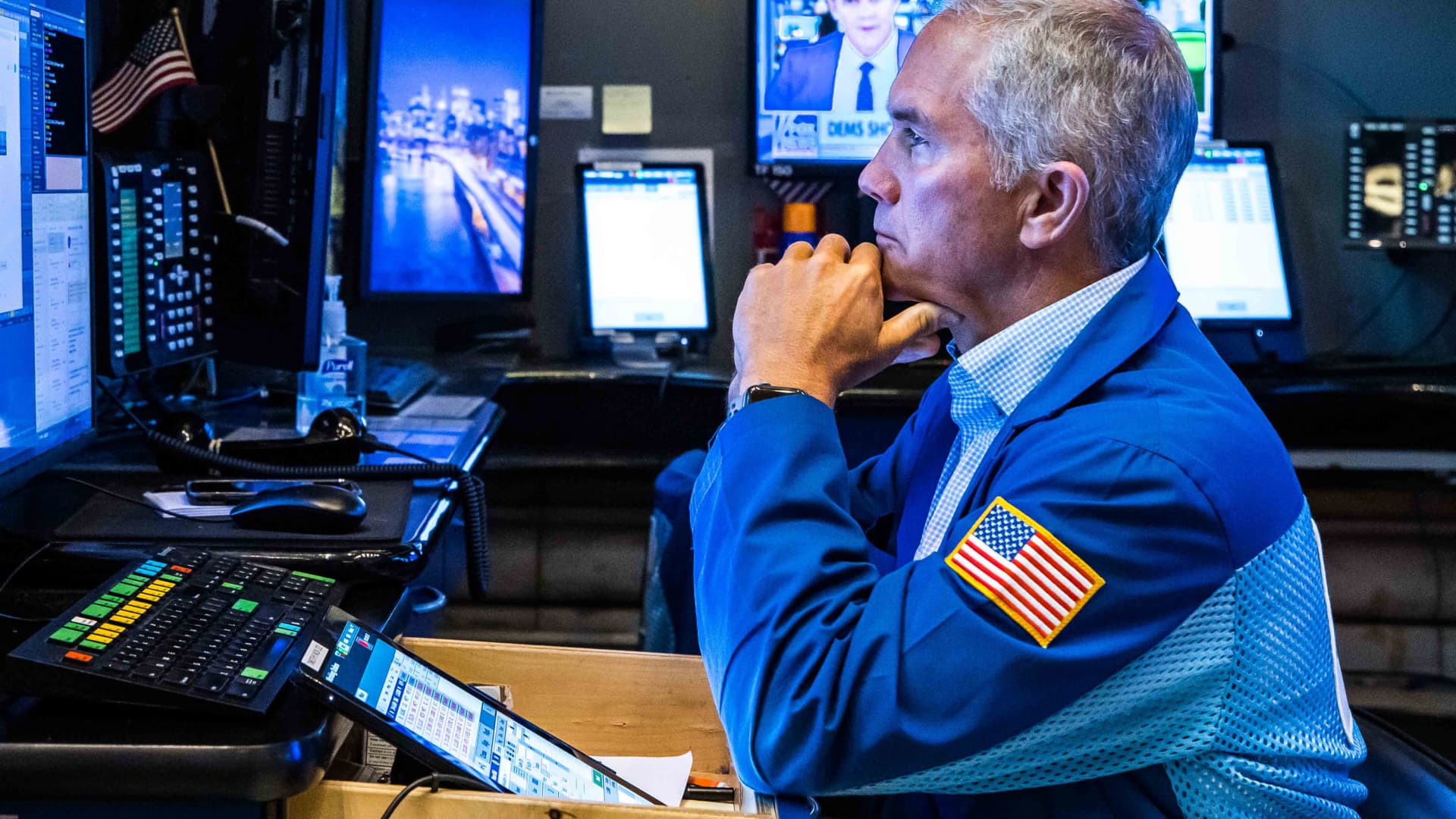
A trader works on the floor of the New York Stock Exchange on Aug. 4, 2022.
Source: NYSE
Stock futures climbed in overnight trading Sunday as the market seeks to rebound into the Thanksgiving holiday week after a slide that’s knocked the air out of this year’s AI bull run.
Futures on the Dow Jones Industrial Average gained 200 points. S&P 500 futures rose 0.6% and Nasdaq-100 futures increased 0.8%. The stock market is closed on Thursday for Thanksgiving Day, and it shuts down early at 1 p.m. ET on Friday.
Stocks are attempting to build on a strong rebound that started on Friday, after the head of the New York Federal Reserve left the door open to a December interest rate cut. Major averages have still stumbled sharply since the month began, pressured by a reconsideration of sky-high valuations across artificial intelligence-linked names that had powered much of 2025’s market gains.
The S&P 500 slipped 2% last week, bringing its November decline to 3.5%. The Nasdaq Composite shed 2.7% in the prior week and is down 6.1% for the month. The 30-stock Dow fell 1.9% last week and is off 2.8% month-to-date.
The final stretch of November may be no easier. With trading volumes expected to thin out in the coming days and few meaningful catalysts ahead of the Fed’s December policy meeting, volatility could pick up.
“Investors hate noise. They crave certainty, and the market simply cannot deliver that right now,” Mark Malek, CIO at Siebert Financial, said in a note.
Key macro events this week include October U.S. retail sales and October Producer Price Index data on Tuesday, both of which could help shape expectations heading into the Fed’s final meeting of the year.
Suranjana TewariAsia business correspondent, Hokkaido, Japan
Getty Images
Hokkaido is a tourism and agricultural region, but Rapidus is making chips there too
The island of Hokkaido has long been an agricultural powerhouse – now Japan is investing billions to turn it into a global hub for advanced semiconductors.
More than half of Japan’s dairy produce comes from Hokkaido, the northernmost of its main islands. In winter, it’s a wonderland of ski resorts and ice-sculpture festivals; in summer, fields bloom with bands of lavender, poppies and sunflowers.
These days, cranes are popping up across the island – building factories, research centres and universities focused on technology. It’s part of Japan’s boldest industrial push in a generation: an attempt to reboot the country’s chip-making capabilities and reshape its economic future.
Locals say that beyond the cattle and tourism, Hokkaido has long lacked other industries. There’s even a saying that those who go there do so only to leave.
But if the government succeeds in turning Hokkaido into Japan’s answer to Silicon Valley – or “Hokkaido Valley”, as some have begun to call it – the country could become a new contender in the $600bn (£458bn) race to supply the world’s computer chips.
An unlikely player
At the heart of the plan is Rapidus, a little-known company backed by the government and some of Japan’s biggest corporations including Toyota, Softbank and Sony.
Born out of a partnership with IBM, it has raised billions of dollars to build Japan’s first cutting-edge chip foundry in decades.
The government has invested $12bn in the company, so that it can build a massive semiconductor factory or “fab” in the small city of Chitose.
In selecting the Hokkaido location, Rapidus CEO Atsuyoshi Koike points to Chitose’s water, electricity infrastructure and its natural beauty.
Mr Koike oversaw the fab design, which will be completely covered in grass to harmonise with Hokkaido’s landscape, he told the BBC.
Local authorities have also flagged the region as being at lower risk of earthquakes compared to other potential sites in Japan.
A key milestone for Rapidus came with the delivery of an extreme ultraviolet lithography (EUV) system from the Dutch company ASML.
The high-tech machinery helped bring about Rapidus’ biggest accomplishment yet earlier this year – the successful production of prototype two nanometre (2nm) transistors.
These ultra-thin chips are at the cutting edge of semiconductor technology and allow devices to run faster and more efficiently.
It’s a feat only rival chip makers TSMC and Samsung have accomplished. Intel is not pursuing 2nm, it is leapfrogging from 7nm straight to 1.8nm.
“We succeeded in manufacturing the 2nm prototype for the first time in Japan, and at an unprecedented speed in Japan and globally,” Mr Koike said.
He credits the IBM partnership for helping achieve the breakthrough.
Tie-ups with global companies are essential to acquiring the technology needed for this level of chips, he added.
The sceptics
Rapidus is confident that it is on track to mass produce 2nm chips by 2027. The challenge will be achieving the yield and quality that is needed to survive in an incredibly competitive market – the very areas where Taiwan and South Korea have pulled ahead.
TSMC for example has achieved incredible success in mass production, but making high-end chips is costly and technically demanding.
In a 2024 report, the Asean+3 Macroeconomic Research Office highlighted that although Rapidus is receiving government subsidies and consortium members are contributing funds: “The financing falls short of the expected 5 trillion yen ($31.8bn; £24.4bn) needed to start mass production.”
The Center for Security and International Studies (CSIS) has previously said: “Rapidus has no experience in manufacturing advanced chips, and to date there is no indication that it will be able to access actual know-how for such an endeavour from companies with the requisite experience (ie TSMC and Samsung).”
Finding customers may also be a challenge – Samsung and TSMC have established relationships with global companies that have been buying their chips for years.
The lost decades
Nevertheless, Japan’s government is pouring money into the chip industry – $27bn between 2020 and early 2024 – a larger commitment relative to its gross domestic product (GDP) than the US made through the Biden-era CHIPS Act.
In late 2024, Tokyo unveiled a $65bn package for Artificial Intelligence (AI) and semiconductors that could further support Rapidus’s expansion plans.
This comes after decades of decline. Forty years ago Japan made more than half of the world’s semiconductors. Today, it produces just over 10%.
Many point to US-Japan trade tensions in the 1980s as a turning point.
Naoyuki Yoshino, professor emeritus at Keio University, said Japan lost out in the technology stakes to Taiwan and South Korea in the 1980s, leaving domestic companies weaker.
Unlike its rivals, Japan failed to sustain subsidies to keep its chipmakers competitive.
But Mr Koike says that mentality has changed.
“The [national] government and local government are united in supporting our industry to revive once again.”
Getty Images
Rapidus has already achieved a production prototype of a 2nm chip
Japan’s broader economic challenges also loom large. Its population is shrinking while the number of elderly citizens continues to surge. That has determined the national budget for years and has contributed to slowing growth.
More than a third of its budget now goes to social welfare for the elderly, and that squeezes the money available for research, education and technology, Prof Yoshino says.
Japan also faces a severe shortage of semiconductor engineers – an estimated 40,000 people in the coming years.
Rapidus is partnering with Hokkaido University and others to train new workers, but agrees it will have to rely heavily on foreigners, at a time when public support for workers coming into the country for employment is low.
Growing an ecosystem
The government’s push is already attracting major global players.
TSMC is producing 12–28nm chips in Kumamoto, on the south-western island of Kyushu – a significant step for Japan, even if it lags behind the company’s cutting-edge production in Taiwan.
The expansion has transformed the local economy, attracting suppliers, raising wages, and leading to infrastructure and service developments.
Japan’s broader chip revival strategy appears to be following a playbook: establish a “fab”, and an entire ecosystem will tend to follow.
TSMC started building a second plant on Kyushu in October this year, which is due to begin production by the end of 2027.
Beyond Rapidus and TSMC, local players like Kioxia and Toshiba are also getting government backing.
Kioxia has expanded fabs in Yokkaichi and Kitakami with state funds and Toshiba has built one in Ishikawa. Meanwhile, ROHM has been officially designated as a company that provides critical products under Tokyo’s economic security framework.
American memory chipmaker Micron will also receive $3.63bn in subsidies from the Japanese government to grow facilities in Hiroshima, while Samsung is building a research and development facility in Yokohama.
Hokkaido is seeing similar momentum. Chipmaking equipment companies ASML and Tokyo Electron have both opened offices in Chitose, off the back of Rapidus building a production facility there.
“This will make a form of ‘global ecosystem’,” Mr Koike says, “where we work together to be able to produce semiconductors that contribute to the world.”
Getty Images
The CEO of Rapidus says the firm’s edge is bespoke chips that can be delivered quickly
Mr Koike said Rapidus’s key selling point would be – as its name suggests – an ability to produce custom chips faster than competitors, rather than competing directly with other players.
“TSMC leads the world, with Intel and Samsung close behind. Our edge is speed – we can produce and deliver chips three to four times faster than anyone else. That speed is what gives us an edge in the global semiconductor race,” Mr Koike said.
Big bet
Global demand for chips is surging with the rise of AI, while Japan’s automakers – still recovering from pandemic-era supply shocks – are pressing for more reliable, domestically or regionally sourced production across the entire supply chain, from raw materials to finished chips.
Securing control over chip manufacturing is being seen as a national security priority, both in Japan and elsewhere, as recent trade frictions and geopolitical tensions between China and Taiwan raise concerns around the risks of relying on foreign suppliers.
“We’d like to provide products from Japan once again – products that are powerful and with great new value,” Mr Koike said.
For Japan’s government, investing in Rapidus is a high-stakes gamble to revive its semiconductor industry and more broadly its tech power.
And some analysts say it may be the country’s best chance to build a domestic ecosystem to supply advanced chips to its many manufacturers, and one day become a formidable challenger in the global market.
(Bloomberg) — Asian markets look set for a positive open, supported by improved sentiment over potential Federal Reserve rate cuts and reports that US officials may permit the sale of Nvidia AI chips to China.
Futures indicate shares in Australia and Hong Kong will climb in early trading after the S&P 500 closed 1% higher on Friday. China’s benchmark may be buoyed by advances in a gauge of US-listed counterparts on Friday, while Japanese markets are closed for a holiday.
Risk sentiment improved on Wall Street after Bloomberg News reported US officials are having early talks on whether to let Nvidia sell its H200 artificial intelligence chips to China. The market also got an injection of hope after Fed Bank of New York President John Williams suggested a near-term rate cut remains a possibility.
“Expect Asian markets to start on the front foot,” said Nick Twidale, chief market analyst at AT Global Markets. “But given the moves that we saw last week, and the potential for more volatility in the coming days, investors will be understandably hesitant to throw the kitchen sink on positive risk sentiment.”
Markets saw a resurgence in volatility last week, with uncertainty over the Fed’s ability to cut rates also unsettling investors, leading the dollar to notch its best weekly advance in a month. Assets favored by retail momentum traders like crypto and AI winners saw wild swings, with the selloff in Asian tech stocks causing the MSCI Asia-Pacific Index to drop the most since April.
US debt climbed on Friday after Williams, seen as a close ally to Chair Jerome Powell, said he sees room to ease policy in the near term, as downside risks to employment have increased while upside risks to inflation have eased. While traders boosted bets on a December cut, officials remain split on whether to lower rates, with Boston Fed chief Susan Collins indicating her mind isn’t made up about a policy move.
Elsewhere, the euro and pound were steady as fiscal pressures in Europe also take focus. France’s National Assembly rejected part of the 2026 budget in the early hours of Saturday morning, highlighting the uncertainties surrounding Prime Minister Sebastien Lecornu’s approach to tackling the bloated deficit.
The UK government at the weekend said it would freeze rail fares in the budget due Wednesday. It’s one of several affordability measures expected as Chancellor of the Exchequer Rachel Reeves seeks to offset the political pain of having to raise as much as £25 billion ($33 billion) in tax hikes and spending restraint to stabilize the UK’s public finances.
“The spending cuts and revenue raising measures must be judged by the market to be credible,” Commonwealth Bank of Australia strategists led by Joseph Capurso wrote in a note to clients. “The risk is the budget will be judged unfavorably, raising UK government bond yields and weighing on GBP/USD.”
In commodities, oil fell Friday as traders assessed the prospect of a Ukraine-Russia peace deal that would add supply to a saturated market. Gold closed slightly lower.
Some of the main moves in markets:
Currencies
The euro was little changed at $1.1513 as of 7:23 a.m. Tokyo time The Japanese yen was little changed at 156.47 per dollar The offshore yuan was little changed at 7.1066 per dollar The Australian dollar was little changed at $0.6458 Cryptocurrencies
Bitcoin was little changed at $87,908.98 Ether fell 0.2% to $2,833.48 Bonds
Australia’s 10-year yield declined one basis point to 4.45% Stocks
S&P/ASX 200 futures rose 1.1% on Friday Hang Seng futures rose 1.2%
Nov 24 (Reuters) – Qube Holdings (QUB.AX), opens new tab said on Monday that Macquarie Asset Management, a unit of Macquarie (MQG.AX), opens new tab, submitted a non-binding proposal to acquire all the shares of Qube, valuing the logistics firm at A$11.6 billion ($7.49 billion), including debt.
The offer of A$5.20 cash per share represents a 27.8% premium to Qube’s closing price of A$4.07 on Friday, and follows negotiations after a lower unsolicited offer, Qube said.
Sign up here.
“This proposal highlights the strength of Qube’s assets and operations. We will work constructively to ensure the best outcome for our shareholders,” Qube Chairman John Bevan stated.
The board of Qube, Australia’s largest integrated provider of import and export logistics, has signed an exclusivity agreement granting Macquarie Asset Management a due diligence period until February 1, 2026.
The offer price will be adjusted if Qube declares any future dividends.
The deal is subject to due diligence, regulatory approvals, and satisfactory completion of a scheme implementation agreement.
($1 = 1.5477 Australian dollars)
Reporting by Adwitiya Srivastava in Bengaluru; Editing by Edmund Klamann and Richard Chang
Our Standards: The Thomson Reuters Trust Principles., opens new tab
SYDNEY--Australian logistics operator Qube granted Macquarie Asset Management exclusive due diligence after the local asset manager proposed a US$7.5 billion takeover.
Qube on Monday said that MAM, a unit of ASX-listed Macquarie Group, submitted an all-cash proposal worth 5.20 Australian dollars, or US$3.36, a share. The proposal implied an enterprise value of about A$11.6 billion, Qube said.
Qube, which offers import and export services including road and rail transport, said the proposal followed an initial lower-value approach from MAM.
Qube's directors intend to unanimously recommend the proposal if it is formalized as a binding offer.
MAM has exclusive due diligence until Feb. 1.
"The proposal from Macquarie Asset Management is a reflection of the strength of Qube's business model and our assets, and the quality of our people and culture," Qube Chairman John Bevan said.
How is the legendary automaker Ford Motor Company (NYSE: F) incorporating AI into its operations to innovate and transform its business for the 21st century?
Just over a century ago, Ford pioneered one of the most significant technology transformations of our times–the introduction of the automobile. In 1903, Henry Ford incorporated the Ford Motor Company in Dearborn, Michigan, followed by the introduction of the Ford Model T in 1908–widely credited with having revolutionized both transportation and American industry.
Today, Ford is betting on the next stage of technology innovation–AI. With annual revenues of $185 billion, Ford ranks 19 on the Fortune 1000, and markets automobiles and commercial vehicles across the globe. So, how does a company that pioneered an earlier era of innovation adopt the next wave, manifested by artificial intelligence (AI), to optimize its business operations for the next generation of customers?
AI and Data Leadership at Ford
I recently posed this question and others on the topic of AI and data transformation and leadership to Franziska (Fran) Bell, who has served as chief data, AI, and analytics officer (CDAAO) for Ford since January 2025. Bell previously was the CTO at bp and held tech executive roles at Toyota Research Institute and Uber. She earned a PhD in theoretical chemistry from the University of California, Berkeley. Earlier this year, Bell was recognized as Chief Data Officer of the Year and named to the AI100, Top 100 Women in AI and Top 100 Women in Tech.
Bell explains her AI and data leadership role at Ford, commenting, “My primary role is to closely partner with the business to drive improved user experiences and tangible business value at scale.” She adds, “My mandate is to ensure that we are not only leading in AI application but also treating our data as the strategic asset it is.”
Bell elaborates on her primary responsibilities, including:
Delivering Business Value: Ultimately, the mandate of the chief data, AI, and analytics officer at Ford is to ensure that the company’s investments in data and AI translate into measurable business impact.
Driving Strategy and Vision: As CDAIO for Ford, Bell is responsible for defining and aligning the company around its enterprise-wide Data and AI strategies to ensure that Ford is making the right investments to maintain a competitive edge.
Enabling the Business: Bell’s organization provides the foundational platforms, such as the Enterprise Data Platform (EDP), and democratized tools that empower teams across Ford to build and deploy AI solutions securely and efficiently. Bell notes that Ford had the foresight to centralize its data team 10 years ago. This provides the advantage, explains Bell, to “connect the dots across the company, and sets us up nicely to re-use technology, making us faster and more efficient.”
Governance and Oversight: Bell chairs Ford’s Enterprise Data Council, which governs the company’s data assets, platform usage, and technology investments. This ensures that Ford is using its resources effectively, avoiding duplicative efforts, and building on a common, scalable foundation. It also ensures that Ford is protecting personal information and ensuring Ford has the appropriate approaches to protecting consumer privacy.
Using AI and Data to Transform the Enterprise at Ford
AI is being developed as a core capability across Ford, notes Bell. Data is a fundamental underpinning to all aspects of Ford’s business, including design, engineering, testing and safety, manufacturing and quality, marketing and sales, as well as back-office systems and customer support. “We use data for virtually everything we do”, adds Bell. “For a company with a 120-year history, our unique and vast data sets—spanning decades of design, engineering, safety, connected vehicle, and manufacturing data—are invaluable.”
Bell elaborates, “Our strategy is centered on capitalizing on Ford’s data advantage.” She continues, “We’re not just collecting data; we are positioning it as a core corporate asset through our Enterprise Data Platform (EDP). This is the cornerstone of our efforts, designed to be the authoritative source for analytics and AI-driven insights.” Ford is combining its wealth of data with work to deeply embed AI as a core capability across every business function.”
Ford is moving beyond isolated projects to create a truly integrated and intelligent ecosystem of AI and data. Bell explains, “This means weaving AI into the fabric of our core processes—from the initial design concept all the way through to manufacturing and the customer ownership experience.” She adds, “The goal is to create a holistic system where data and insights flow seamlessly, allowing us to innovate faster and drive business value at Ford’s scale.”
Central to this vision at Ford is the concept of AI as a digital partner for the Ford workforce. Bell explains, “We believe AI’s greatest value is realized not by replacing human ingenuity, but by augmenting it.” She continues, “We are building powerful ‘human-machine teams’ where AI assists in complex data analysis, runs simulations, and automates repetitive tasks, freeing our talented engineers, designers, and business leaders to focus on what they do best: strategic thinking, creative problem-solving, and building the future of mobility.”
Ford’s ‘Big Bet’ AI Projects
Central to Ford’s plans to use AI to deliver transformative value across business lines is the idea of what Ford calls its “big bet” AI projects. Bell comments, “While these projects are designed to deliver transformative value across the business, we are at the same time democratizing access, encouraging individuals to use AI in their jobs, and seeing lots of projects percolate up out of experimentation.” Examples of Ford’s AI initiatives include:
AI-Accelerated Vehicle Design: Ford designers now use generative AI to turn a single sketch or use a set of parameters to render hundreds of high-fidelity images and 3D models almost instantly. This elevates Ford designers to creative directors, allowing them to explore a vastly wider range of possibilities.
Virtual Wind Tunnel: Ford has developed proprietary AI models that reduce the time for a complex aerodynamic simulation from 15 hours to approximately 10 seconds (a 5000x speed increase), with results that are within 2.3% of the traditional physics-based models. This allows Ford engineers to iterate and optimize designs at a speed that was previously unimaginable.
AI-Powered Customer Support: Ford has launched an AI agent on the Ford.com site that acts as a single front door for customer questions. It can query multiple knowledge bases, access tools like a towing calculator, and synthesize the information into one clear, referenced answer, dramatically improving the customer experience.
AI-Supercharged Code Reviews: In software engineering, Ford has implemented an AI-assisted “code reviews-as-a-service” capability. Early results with over 1,000 software engineers have shown a 3x reduction in cycle time, allowing Ford to innovate on digital experiences much faster.
Building an AI & Data Business Culture within Ford
One of the greatest challenges that organizations face in adopting AI and data within their businesses is due to cultural obstacles, according to 92% of organizations surveyed.
Ford is taking measures to build an AI and data culture which will lay a foundation for adoption and business success. Bell explains, “Building a data and AI-driven culture is about empowerment and collaboration — where we constantly show quantifiable business wins and solve real problems across Ford’s business.” She continues, “Along that path, we are making internal data, analytics and AI products intuitive to use, putting the human user at the core of the experience.”
Bell elaborates, “Our data and AI teams are integrated with the various parts of the business, so that data and AI are being deployed where they solve the biggest business problems.” She notes, “Our philosophy is that AI’s greatest value is realized when it augments our talented workforce, creating powerful “human-machine teams.” Bell notes that to achieve this outcome, Ford has focused on three key areas:
Democratizing Access: Ford is currently providing employees at all levels of the organization with access to AI tools and platforms. FordLLM is the internal Ford platform where teams have access to the latest large language models and other AI tools and agents. This puts AI in employees’ hands and is proving very useful for internal productivity, notes Bell. She notes that Ford is currently seeing about 50,000 weekly active users, which represents significant repeated usage.
Fostering an AI-Powered Workforce: Ford is committed to continuous training and upskilling to ensure its workforce can operate at the highest level. Bell explains that it is the goal within Ford to integrate AI where it can augment human potential and not just automate tasks. Bell explains that this means, “co-designing future workflows with our people.” In the first half of 2025, she notes that AI training has reached 10,000 employees within Ford.
Championing Responsible AI: Trust is paramount at Ford. Bell explains, “We champion a ‘human-in-the-loop’ model, where human oversight provides essential judgment and validation.” She continues, “Our AI principles, guided by our AI Technology Council and Ethics Hub, ensure that we innovate responsibly, with a strong focus on data privacy and transparent governance.”
Delivering Business Value from AI and Data Investments at Ford
Delivery of business value from its AI and data investments is a top organizational priority for Ford. Bell explains, “We measure the value of our data and AI investments through a disciplined framework that combines financial rigor with key operational metrics.” She continues, “We have a robust process, run in close partnership with our Finance team, to ensure every significant AI project has a clear business case.”
Beyond direct financial returns, Ford measures business value through a balanced scorecard of key performance indicators (KPIs) that reflect the company’s strategic priorities, including:
Accelerated Delivery: Ford tracks reductions in the cycle times of critical processes. By delivering products and features to market faster–in engineering design, software development, and other domains–Ford can create a significant competitive advantage.
Improved Quality and Reduced Costs: Ford measures the impact of AI on product quality and operational efficiency. This includes tracking improvements in manufacturing defect detection, which in turn helps reduce potential warranty costs and enhances customer satisfaction.
Enhanced Agility: Ford assesses the ability to make faster, more informed decisions across the company. By making data and self-service AI tools more accessible, Ford empowers its teams to respond more quickly to market shifts and customer needs.
Bell comments, “In some cases, business value is achieved by solving quality issues earlier and faster than we have traditionally been able to do. She continues, “In another case, AI is helping software coders with code review, making it three times faster than it used to be.” Bell concludes, “We continuously track the business outcomes of these initiatives to ensure they deliver on their promised value.”
Planning for an AI Future at Ford
Looking ahead to the future, Ford is being tested by forces that are reshaping the automotive industry. These include adapting to technological leaps forward and responding to the emergence of new competitors. The ability to leverage the transformation potential of AI and data will be distinguishing factors for those companies that continue to innovate and lead.
Bell reflects on change and the future of the automotive industry. “At Ford, we see the application of data and AI as fundamental tools to transform our entire enterprise, improve the user experience, and drive tangible business value,” comments Bell. She elaborates, “We view data and AI as critical strategic assets that provide a significant competitive edge. By effectively leveraging these assets, we can develop innovative AI applications rapidly and securely that differentiate us from competitors, from optimizing supply chains to personalizing the customer experience.”
AI and data leadership starts at the top and extends across the Ford organization. “Our leaders are hands-on, actively using our new AI tools themselves”, explains Bell. “By becoming practitioners, our leaders not only gain a deeper understanding of the technology’s potential but also serve as powerful advocates, championing adoption and encouraging employees to integrate these capabilities into their daily work.” She adds, “Our leadership team at Ford is not just embracing data and AI–they are driving it as a core component of our business strategy.”
Bell sums up, “This visible, top-down engagement sends a powerful message across the organization–AI is not just a Tech initiative; it is a fundamental part of how Ford will lead and compete. We think AI will deliver significant business results that will improve cost and quality, make us a more agile business, and will enable Ford to vigorously compete in the future of this industry.” She concludes, “We are making AI available to every employee at Ford, and in doing so we are helping make our teams smarter, faster, and more effective as we redefine automotive excellence.”
Closed reduction is often used to treat distal radius fractures (DRFs). After that, splint immobilization is used to keep the bone in the right position. But, long—term immobilization can cause problems like joint stiffness, long—lasting swelling, and slow bone healing. Rehabilitation training is a commonly employed recovery modality following conservative management of fractures. However, its efficacy is often suboptimal, primarily attributable to two key factors: nonstandardized rehabilitation protocol design and poor patient compliance with prescribed training regimens in terms of both adherence to schedule and completion of required exercise dosage. Earlier studies show that Fu’s Subcutaneous Needling (FSN) therapy can lessen wrist pain and swelling, and also improve joint movement in patients with fractures of DRFs. But we need more evidence to prove it works. This trial wants to see if combining FSN therapy with rehabilitation training can help promote fracture healing and improve post-fracture symptoms in DRFs better and safer when added to conservative treatment, compared to using sham FSN therapy with rehab exercises.
Methods and analysis
This single-center, sham-controlled clinical trial will enroll 84 eligible patients, randomly allocated to two groups (n = 42). The intervention group will receive FSN therapy, while the control group will undergo sham FSN therapy. The treatment schedule includes three sessions in the first week post-reduction, two sessions per week in weeks 2–3, and one session per week in weeks 4–8, totaling 12 sessions. The primary outcome is the time to radiographic union, assessed using a modified Radiographic Union Score for Tibial fractures (RUST) adapted for distal radius fractures. Secondary outcomes include complications (e.g., pain, swelling), functional recovery (measured by the Disabilities of the Arm, Shoulder, and Hand [DASH] score), and radiographic parameters (e.g., volar tilt, radial height).
Discussion
This study is expected to validate the clinical value of FSN therapy as a safe and effective adjunctive approach for rehabilitation following DRFs, bridging the technical gap between conventional conservative treatment and functional recovery.