The U.S. Food and Drug Administration today announced it is sharing information about the agency’s flexible approach to overseeing chemistry, manufacturing and control (CMC) requirements for cell and gene therapies (CGT). The agency’s more flexible approach has been, and is expected to continue to be, helpful in expediting product development and will help guide the FDA’s evaluation of development strategies in preparation for a Biologics License Application (BLA) submission.
“Regulatory flexibility must be tailored for cell and gene therapies,” said FDA Commissioner Marty Makary, M.D., M.P.H. “These are common-sense reforms that will address the unique characteristics of cell and gene therapies and foster more innovation.”
Over the last decade, the FDA’s Center for Biologics Evaluation and Research (CBER) has approved close to 50 CGTs. The transformative potential of these therapies has captured the imagination of the patient community and ignited product development.
“There has been tremendous enthusiasm amongst product developers resulting in an explosive growth of cell and gene therapy submissions, many of which target serious or life-threatening conditions with an unmet medical need,” Vinay Prasad, M.D., M.P.H., Chief Medical and Scientific Officer and Director of the FDA’s Center for Biologics Evaluation and Research. “CBER is eager for stakeholders to know that our effectiveness at exercising greater regulatory flexibility around chemistry, manufacturing and control requirements furthers innovative product development.”
CBER has historically had similar CMC expectations across products, including small-batch products such as CGTs. CGTs are inherently complex biologic products, often individualized for patients, and may need sophisticated manufacturing under particular time constraints. CBER has leveraged its growing experience with CGT products to identify and implement regulatory flexibilities allowed under FDA’s regulations that accommodate the unique characteristics of these innovative therapies, while maintaining rigorous quality standards through appropriate control measures. While there is a long history of making concerted efforts to help sponsors meet standards to assure product safety, purity and potency, the application of flexibilities has not always been fully clear to stakeholders.
“CBER is proactively communicating about regulatory flexibilities that were previously applied case-by-case to select CGT therapies. By communicating these approaches broadly, we aim to expedite product development across the CGT field,” said Vijay Kumar M.D., Acting Director, Office of Therapeutic Products in the FDA’s Center for Biologics Evaluation and Research. “It is vital that every sponsor, no matter the CBER reviewer team they engage with, understand what types of regulatory flexibility may be scientifically acceptable.”
Given the rapid scientific developments witnessed during the decade, it is a high priority for both the agency and the administration to remove barriers and perceived misconceptions that stand in the way of expedited product development. These flexibilities will enable progress while not compromising or undermining the FDA’s ability to assure safety, purity and potency of a product, or weaken the FDA’s dependency on understanding the benefits and risks of both the specific therapy and the disease context.
In June, the FDA hosted a Cell and Gene Therapy Roundtable, bringing together leading experts to discuss advancing the field of cell and gene therapies for patients and innovators.
Related Information
###
Boilerplate
The FDA, an agency within the U.S. Department of Health and Human Services, protects the public health by assuring the safety, effectiveness, and security of human and veterinary drugs, vaccines and other biological products for human use, and medical devices. The agency also is responsible for the safety and security of our nation’s food supply, cosmetics, dietary supplements, radiation-emitting electronic products, and for regulating tobacco products.
New Phase I/II RGX-202 functional data demonstrates long-term, durable treatment effect at pivotal dose at 18 months
Robust patient enrollment in confirmatory trial continues, expect majority of patients to be dosed by planned BLA filing, mid-year
Expecting FDA PDUFA decision and multiple pivotal top-line data readouts in 2026 to support potential commercial launches 2026-2028
In-house manufacturing and strategic global partnerships driving commercial readiness
Presentation at 44th Annual J.P. Morgan Healthcare Conference Wednesday, January 14
ROCKVILLE, Md., Jan. 11, 2026 /PRNewswire/ — REGENXBIO Inc. (Nasdaq: RGNX) highlighted progress and upcoming anticipated milestones across its pipeline of AAV gene therapies for rare and retinal diseases.
“2026 is set to be a transformative year for REGENXBIO, as we enter commercial stage with two near-term catalysts from our three late-stage assets and a clear path to sustained growth,” said Curran Simpson, President and CEO, REGENXBIO. “We are starting the year with exciting new long-term data for our Duchenne program, demonstrating how our comprehensive strategy to maximize the potential for therapeutic benefit across all our programs is resulting in positive outcomes for patients. We are continuing to set the bar high for how potentially life-changing gene therapies are discovered, developed, and manufactured; this year we are sharply focused on advancing our commercial readiness to enable successful launches of these medicines for patients in need.
CLINICAL PROGRAM UPDATES AND 2026 ANTICIPATED MILESTONES
RGX-202 for Duchenne Muscular Dystrophy New Functional Data
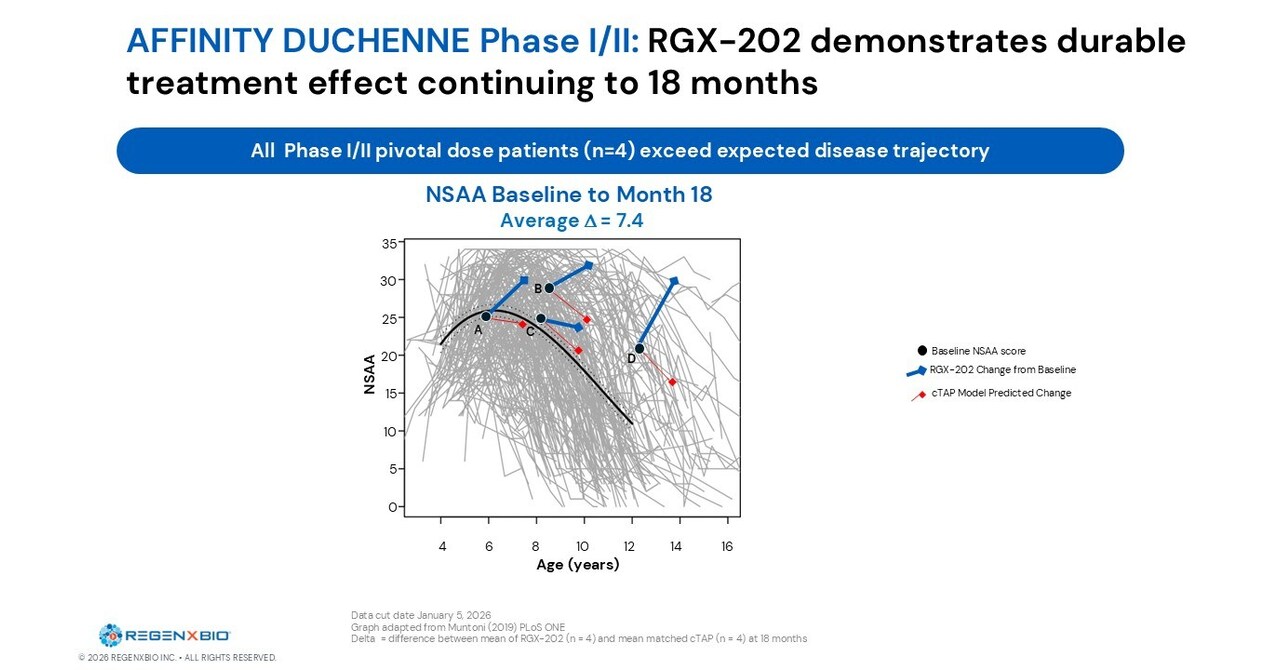
REGENXBIO today announced new, positive 18-month functional data from patients treated with the pivotal dose in the Phase I/II portion of the AFFINITY DUCHENNE® trial (n=4). All patients exceeded expected disease trajectory on the North Star Ambulatory Assessment (NSAA) using the established cTAP disease progression model. RGX-202 recipients improved an average of 7.4 points compared to cTAP. These same patients improved an average of 6.6 points compared to cTAP at 12 months post-treatment. The Company plans to share additional Phase I/II safety, biomarker, and functional data at the MDA Clinical and Scientific Conference in March 2026.
Clinical Trial and Regulatory Milestones
REGENXBIO expects to share pivotal topline data in early Q2 2026 and submit a Biologics License Application (BLA) under the accelerated approval pathway in mid-2026. Following the completion of enrollment in the pivotal trial (n=30) in October 2025, the Company continues to enroll in the confirmatory trial and expects to have majority of this trial enrolled at the time of BLA filing.
Regulatory interactions with the FDA and European Medical Association (EMA) are planned for 1H 2026, supporting the global expansion of the AFFINITY DUCHENNE® trial.
Clemidsogene lanparvovec (RGX-121) for MPS II, also known as Hunter syndrome
FDA PDUFA target date is February 8, 2026. FDA approval would result in receipt of a Priority Review Voucher (PRV), to which REGENXBIO has full rights.
Partner Nippon Shinyaku, with its U.S. subsidiary NS Pharma, is prepared to commercialize clemidsogene lanparvovec following potential approval. REGENXBIO plans to lead the clinical and commercial manufacturing its in-house Manufacturing Innovation Center in Rockville, Md.
Surabgene lomparvovec (sura-vec, ABBV-RGX-314) for wet age-related macular degeneration (wet AMD) and diabetic retinopathy (DR) Sura-vec is being developed in collaboration with AbbVie, and could be the first gene therapy for a non-rare disease, if approved.
Sura-vec is on track to be the first gene therapy for wet AMD. REGENXBIO expects top-line data from ATMOSPHERE® and ASCENT® pivotal trials of sura-vec using subretinal delivery in Q4 2026.
REGENXBIO will initiate a two-part sham injection-controlled Phase IIb/III trial of sura-vec for DR using suprachoroidal delivery. The Company will receive a $100 million milestone payment from AbbVie upon first patient dosed, expected 1H 2026.
Leading Gene Therapy Capabilities REGENXBIO is one of the only gene therapy companies with fully in-house, end-to-end capabilities from capsid engineering and discovery through commercial-ready manufacturing, designed to reliably scale supply and realize the blockbuster potential of its gene therapy portfolio. At the REGENXBIO Manufacturing Innovation Center, in Rockville, Md., REGENXBIO expects to continue to build supply intended for potential commercial launches. Process performance qualification lots have been completed for RGX-202.
REGENXBIO continues to expand the therapeutic potential of AAV gene delivery through capsid discovery and engineering. The Company is approaching IND readiness for the treatment of geographic atrophy using a new capsid that has demonstrated higher transgene expression via suprachoroidal delivery to the eye.
J.P. Morgan Healthcare Conference Presentation President and CEO Curran Simpson will present at the J.P Morgan Healthcare Conference on Wednesday, January 14, 2026 at 10:30 a.m. PT. A live webcast of the presentation can be accessed in the Investors section of REGENXBIO’s website at www.regenxbio.com. An archived replay of the webcast will be available for approximately 30 days following the presentation.
ABOUT REGENXBIO Inc. REGENXBIO is a biotechnology company on a mission to improve lives through the curative potential of gene therapy. Since its founding in 2009, REGENXBIO has pioneered the field of AAV gene therapy. REGENXBIO is advancing a late-stage pipeline of one-time treatments for rare and retinal diseases, including RGX-202 for the treatment of Duchenne; clemidsogene lanparvovec (RGX-121) for the treatment of MPS II and RGX-111 for the treatment of MPS I, both in partnership with Nippon Shinyaku; and surabgene lomparvovec (ABBV-RGX-314) for the treatment of wet AMD and diabetic retinopathy, in collaboration with AbbVie. Thousands of patients have been treated with REGENXBIO’s AAV platform, including those receiving Novartis’ ZOLGENSMA®. REGENXBIO’s investigational gene therapies have the potential to change the way healthcare is delivered for millions of people. For more information, please visit www.REGENXBIO.com.
FORWARD-LOOKING STATEMENTS This press release includes “forward-looking statements,” within the meaning of Section 27A of the Securities Act of 1933, as amended, and Section 21E of the Securities Exchange Act of 1934, as amended. These statements express a belief, expectation or intention and are generally accompanied by words that convey projected future events or outcomes such as “believe,” “may,” “will,” “estimate,” “continue,” “anticipate,” “assume,” “design,” “intend,” “expect,” “could,” “plan,” “potential,” “predict,” “seek,” “should,” “would” or by variations of such words or by similar expressions. The forward-looking statements include statements relating to, among other things, REGENXBIO’s future operations, clinical trials, costs and cash flow. REGENXBIO has based these forward-looking statements on its current expectations and assumptions and analyses made by REGENXBIO in light of its experience and its perception of historical trends, current conditions and expected future developments, as well as other factors REGENXBIO believes are appropriate under the circumstances. However, whether actual results and developments will conform with REGENXBIO’s expectations and predictions is subject to a number of risks and uncertainties, including the timing of enrollment, commencement and completion and the success of clinical trials conducted by REGENXBIO, its licensees and its partners, the timing of commencement and completion and the success of preclinical studies conducted by REGENXBIO and its development partners, the timing or likelihood of payments from AbbVie or Nippon Shinyaku, the monetization of any priority review voucher, the timely development and launch of new products, the ability to obtain and maintain regulatory approval of product candidates, the ability to obtain and maintain intellectual property protection for product candidates and technology, trends and challenges in the business and markets in which REGENXBIO operates, the size and growth of potential markets for product candidates and the ability to serve those markets, the rate and degree of acceptance of product candidates, and other factors, many of which are beyond the control of REGENXBIO. Refer to the “Risk Factors” and “Management’s Discussion and Analysis of Financial Condition and Results of Operations” sections of REGENXBIO’s Annual Report on Form 10-K for the year ended December 31, 2024, and comparable “risk factors” sections of REGENXBIO’s Quarterly Reports on Form 10-Q and other filings, which have been filed with the SEC and are available on the SEC’s website at WWW.SEC.GOV. All of the forward-looking statements made in this press release are expressly qualified by the cautionary statements contained or referred to herein. The actual results or developments anticipated may not be realized or, even if substantially realized, they may not have the expected consequences to or effects on REGENXBIO or its businesses or operations. Such statements are not guarantees of future performance and actual results or developments may differ materially from those projected in the forward-looking statements. Readers are cautioned not to rely too heavily on the forward-looking statements contained in this press release. These forward-looking statements speak only as of the date of this press release. Except as required by law, REGENXBIO does not undertake any obligation, and specifically declines any obligation, to update or revise any forward-looking statements, whether as a result of new information, future events or otherwise.
Zolgensma® is a registered trademark of Novartis Gene Therapies. All other trademarks referenced herein are registered trademarks of REGENXBIO.
CONTACTS: Dana Cormack Corporate Communications [email protected]
George E. MacDougall Investor Relations [email protected]
For certain Sydney communities, protecting their identity means pushing back against the fast food giants.
In recent months, some inner-city suburbs have rallied in a bid to reject development proposals, voicing their opinions on social media, in submissions to council and even with vandalism.
It comes as the number of Australian fast food and takeaway businesses in the country surpassed 26,000 in 2025, IbisWorld data shows.
The country’s top three remain the same as five years ago, according to Roy Morgan Research: McDonald’s, KFC and Hungry Jack’s.
These communities explain why they have fought to largely remain free of these popular outlets.
‘Four steps backwards’
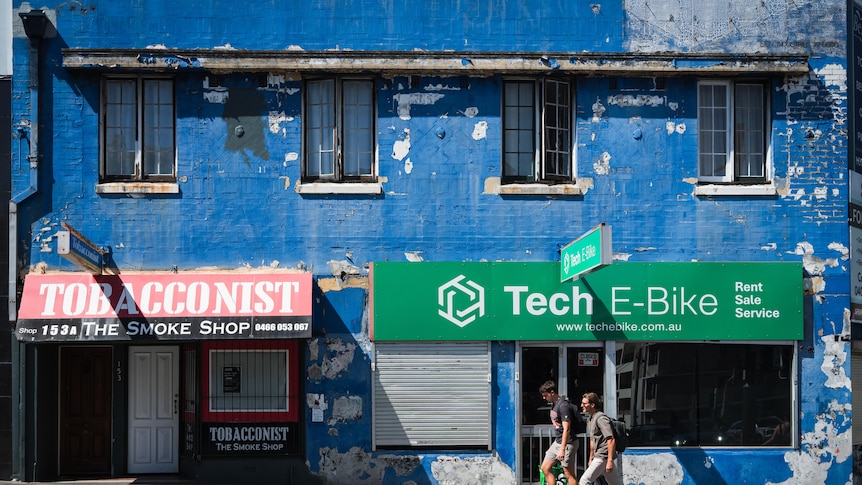
The site which was proposed for a 24 hour fast-food outlet and an impression of what the proposed McDonald’s would have looked like. / ABC News: Timothy Ailwood/McDonald’s
In May, a $3 million development application for a 24-hour, two-storey McDonald’s in Redfern was rejected by the City of Sydney Council.
Out of 286 public submissions, only 17 supported the proposal, which would have seen the first of Australia’s top three fast food giants in the inner-citysuburb.
Supporters of the proposal mentioned it would increase foot traffic and boost surroundinglocal business.
Aboriginal Medical Services Redfern CEO LaVerne Bellear objected, raising concerns about public health.
“Research has shown that the proliferation of fast food outlets correlates with increased rates of obesity, diabetes, and other diet-related illnesses, which disproportionately affect Aboriginal and Torres Strait Islander populations,” Ms Bellear stated in her submission.
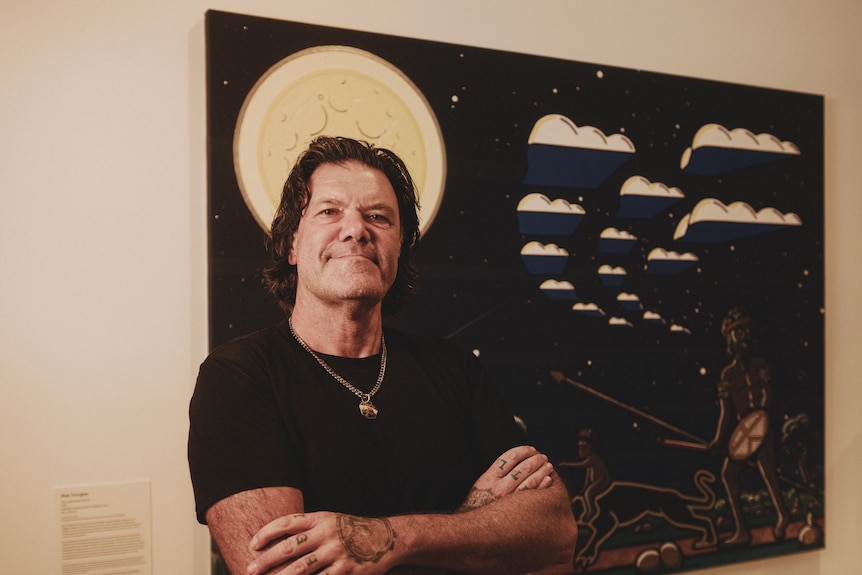
Douglas has strong connections with the people and places of Redfern. (Supplied: Eddy Summers)
Dhungatti Archibald Prize-winning artist Blak Douglas, who lived and worked in Redfern for 17 years, shared similar views.
Douglas said fast food giants would detract from First Nations businesses trying to improve local nutrition.
“That’s like one step forward in our community with a focus on native nutrition, and then it’s four steps backwards with a fast-food franchise coming in there,”
he said.
In a statement, a McDonald’s spokesperson said every restaurant contributed to the local community “by creating 100 new jobs … and providing ongoing training and development for employees”.
The company said it “values community feedback” and supports community causes through its in-house charity.
Second time lucky?
Newtown in Sydney’s inner west has also been pushing back.
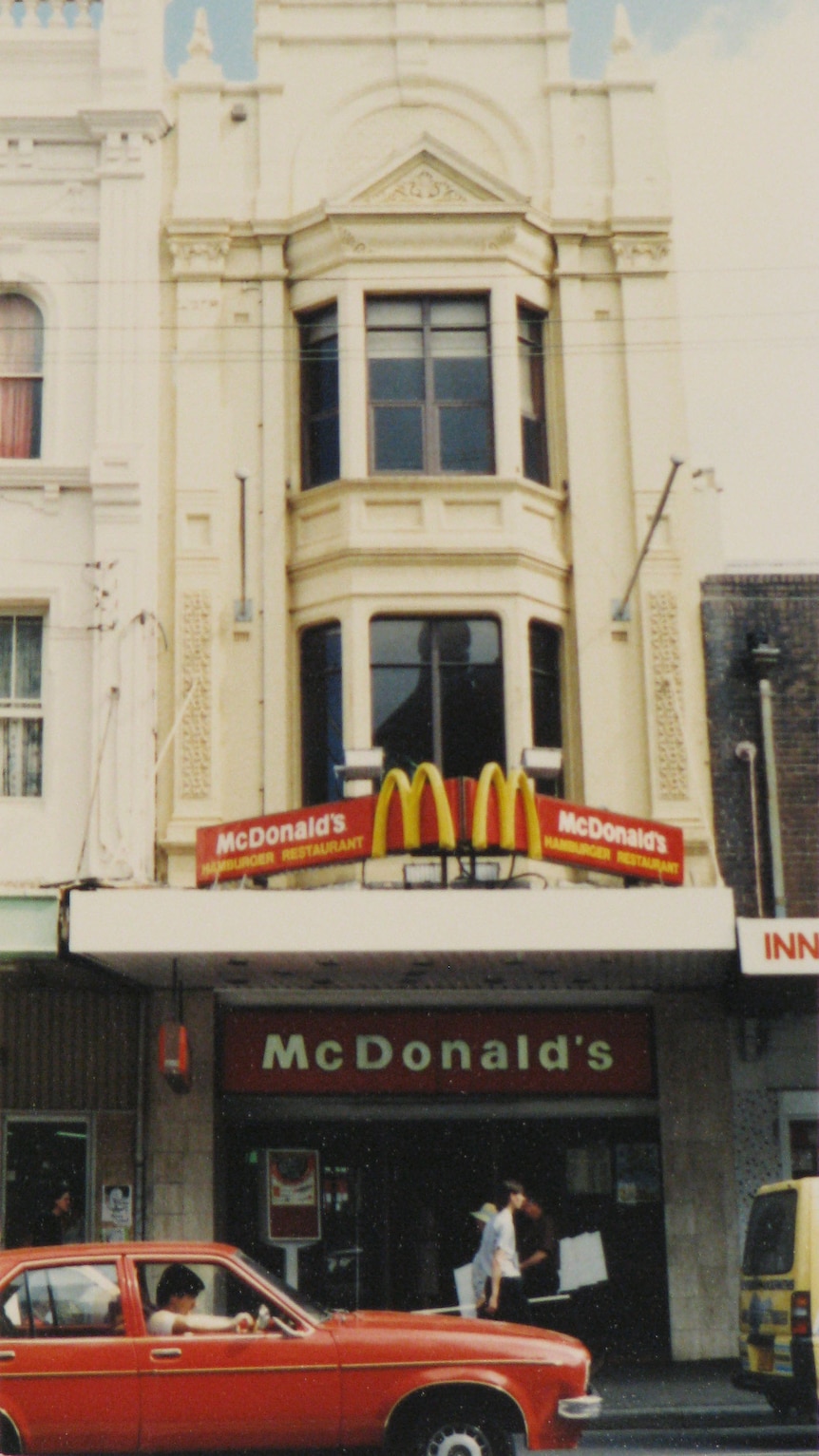
McDonald’s opened for the first time in the area in 1989.
McDonald’s on King Street at Newtown in the early 1990s. (Supplied: City of Sydney Archives)
Eleven years later, it closed, citing the “changing demographics of the Newtown area, particularly in King Street”.
In 2025, the company tried to return with a 24-hour outlet.
Out of 1,433 public submissions to the development proposal, only six supported it.
The City of Sydney council rejected the proposal in October, saying the application lacked merit, would not comply with late trading, did not have toilets for customers and its footpath would be hazardous for delivery drivers.
Newtown resident of 18 years, Liam Coffey, said Newtown was “full of heart and character”.
The content creator said residents were not afraid to voice their opinions because its “existence has been political” and diverse.
“We as a community have always been one to stand up and to not just take it lying down and just accept what the big man tells us,”
Mr Coffey said.
Mr Coffey was a fierce opponent of the fast food outlet proposals in Newtown. (Supplied)
When the Newtown McDonald’s was proposed, Mr Coffey took to the streets to make videos about the community’s response, which amassed thousands of views.
“I think without a doubt, my use of social media has directly impacted this decision,” he said.
Despite working at McDonald’s when he was younger, Mr Coffey disagreed with supporters, saying fast food companies would bring jobs.
“They [existing local employees] are going to lose their jobs, they’re going to cut their hours, because a fast food local business is not going to be able to compete with the big ones,” he said.
‘We can’t survive it’
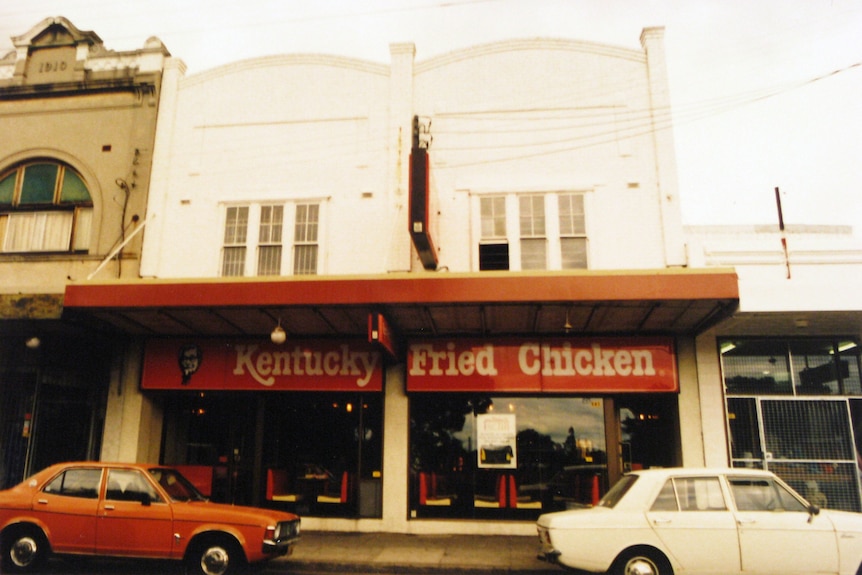
This is what the KFC looked like in the early 90s in Newtown. (Supplied: City of Sydney Archives)
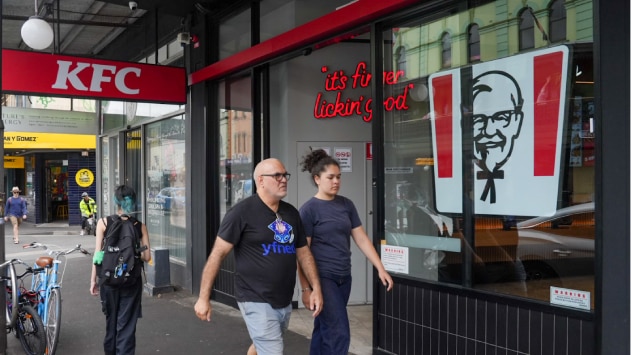
In July last year, KFC made a comeback to Newtown decades after its closure, but this time on King Street.
It replaced an Indian and Sri Lankan restaurant.
The development proposal received 11 submissions, with one supporting the development.
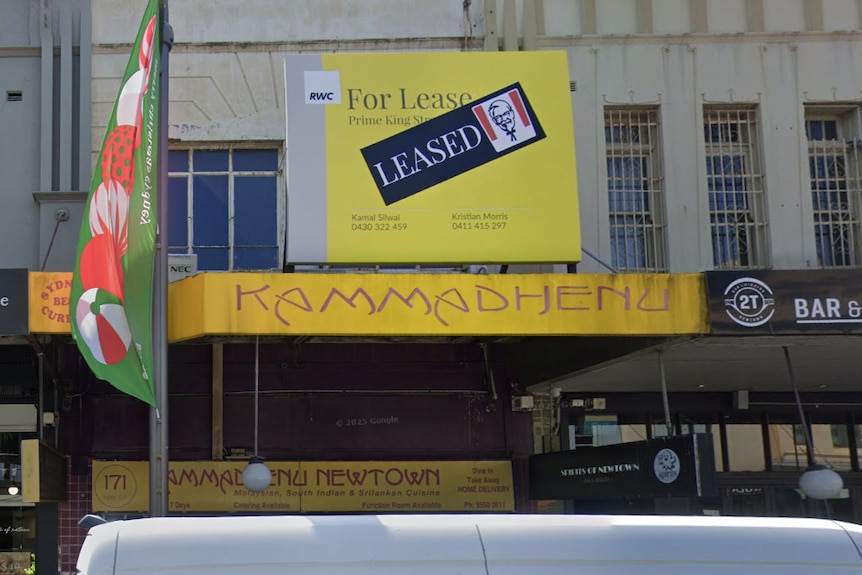
The KFC franchise replaced Indian and Sri Lankan restaurant Kammadhenu. / The Kentucky Fried Chicken fast food outlet on 171 King Street Newtown. (2/04/26)
A City of Sydney spokesperson said KFC was approved and McDonald’s was not, as the former only wanted 60 per cent of floor space to be kitchen and back of house, compared to its competitor’s 84 to 90 per cent.
Broaster Chicken Newtown owner Md Rubel said business had been a “disaster” ever since.
“[The] last six, seven months it’s going really bad because I think it’s pretty similar food, and obviously we can’t beat the price,”
he said.
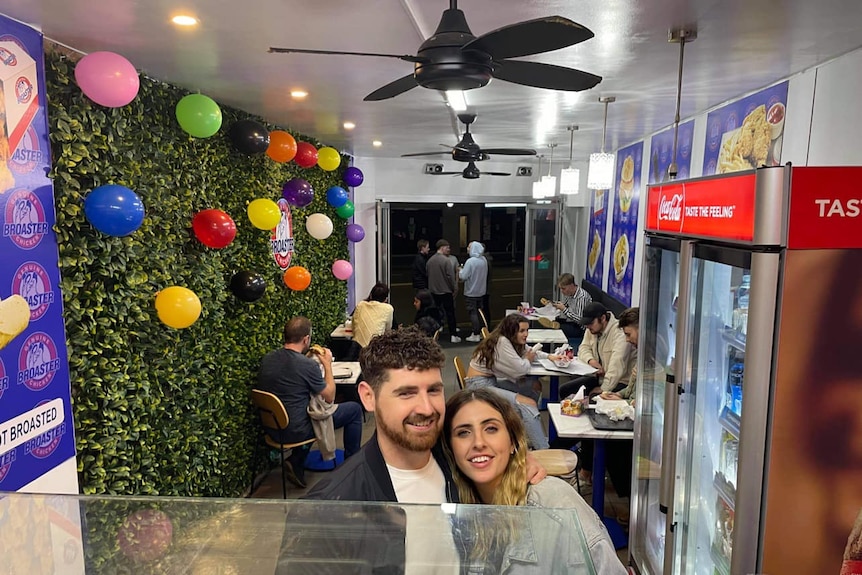
Broaster Chicken has been operating in Newtown for almost six years now. (Supplied)
Mr Rubel said he struggles to pay rent — $10,000 minimum per month — and suppliers on time and had started a second job as a driver to provide for his family.
He said if McDonald’s did manage to build a restaurant in the area, his business would not survive.
“I’ll have to shut the shop … We can’t survive it.”
Eleven submissions were made to council with just one supporting the development. (Supplied: Google Maps)
About 10 minutes away, McDonald’s built a restaurant in Marrickville after it was approved last year through a Complying Development Certificate, which means it did not need public or council support.
During construction in September, the site was vandalised with “McF*** off”.
The Marrickville McDonald’s construction site was vandalised in September. (ABC News: Simon Amery)
McDonald’s said in a statement the business represented a $5 million investment into the local economy.
The company did not respond to questions asking how many development applications were submitted across the country in the past year, or how many of those were rejected.
Corporate model vs local identity
Ms Morrison says some suburbs are very protective of their “vibe” and “identity”.
(Supplied)
Nicky Morrison, who is the professor of planning and co-director of the Urban Transformations Research Centre at Western University, said certain areas like Redfern and Newtown opposed fast food because of local identity and vibe.
“They have a very strong sense of place, and they’ve invested decades into shaping the local culture, the street life, the food scene and the character of their high streets,” she said.
“They’re not just objecting to a building or a business, they’re very much objecting to what they feel is a loss of social and cultural fabric of their neighbourhood.“
Ms Morrison noted some parts of Sydney had different responses.
“Fast food can be heavily constrained to lower income areas because they really do have fewer resources and less capacity to mobilise opposition,” she said.
“It does raise an equity question. I think it’s not just about planning here, it’s also about health outcomes and who’s paying for the impact of these developments.”
Bucking the trend
Fabio Stefanelli’s La Favola Italian restaurant in Newtown is directly across from the new KFC.
Mr Stefanelli owns an Italian restaurant across the road from a fried chicken fast food giant. (Supplied)
Mr Stefanelli said he “didn’t really care” about the new addition.
“Lots of people still complain … but honestly, I prefer to see a place tidy, clean and [with] good vibes, compared to a closing shop [because of high rents],”
he said.
Mr Stefanelli said it had attracted more people and diversified food options available after 10pm.
Fashion store owner Ruth Tate, who has operated on the street for six years, said she understood why KFC wanted to be on King Street from a business perspective.
“Lots of people have now moved to Newtown for nightlife because Kings Cross died with the lockout laws,” she said.
SOUTH SAN FRANCISCO, Jan. 08, 2026 (GLOBE NEWSWIRE) — Vaxart, Inc. (OTCQX: VXRT) (“Vaxart or “the Company”), a clinical-stage biotechnology company developing a range of oral recombinant pill vaccines based on its proprietary delivery platform, today announced that it will participate in the Global BioInnovation Forum, a virtual gathering of senior leaders building and scaling next-generation life science and health innovation companies.
Presentation Details:
Speakers: Steven Lo, Chief Executive Officer, Sean Tucker, Ph.D., Founder and Chief Scientific Officer, and James F. Cummings, M.D., Chief Medical Officer Date: Tuesday, January 13, 2026 Time: 11:30am PT, 2:30pm ET Registration and Webcast: Click Here
The webcast will be available on the Company’s investor relations website at https://investors.vaxart.com for 30 days following the conclusion of the event.
About Vaxart Vaxart is a clinical-stage biotechnology company developing a range of oral recombinant vaccines based on its proprietary delivery platform. Vaxart vaccines are designed to be administered using pills that can be stored and shipped without refrigeration and eliminate the risk of needle-stick injury. Vaxart believes that its proprietary pill vaccine delivery platform is suitable to deliver recombinant vaccines, positioning the company to develop oral versions of currently marketed vaccines and to design recombinant vaccines for new indications. Vaxart’s development programs currently include pill vaccines designed to protect against coronavirus, norovirus and influenza, as well as a therapeutic vaccine for human papillomavirus (HPV), Vaxart’s first immune-oncology indication. Vaxart has filed broad domestic and international patent applications covering its proprietary technology and creations for oral vaccination using adenovirus and TLR3 agonists.
Contact:
Vaxart Media and Investor Relations: FINN Partners IR@vaxart.com
Next year’s Australasian Fire and Emergency Service Authorities Council (AFAC) and Women and Firefighting Australasia (WAFA) conferences are being held in Melbourne between 18 to 21 August 2026.
The call for abstracts is now open
As part of AFAC26 and WAFA26, we want to showcase the high-quality and innovative mahi (work) happening across Fire and Emergency New Zealand. This is a great opportunity to showcase your mahi to people from across the emergency services sector.
We’re seeking abstract submissions of mahi that reflects the themes of next year’s conferences. You can submit an abstract for inclusion as either a poster or a presentation at the event.
Please do not submit your abstract via the websites; the information is for guidance only.
Next steps
If you’re planning to submit an abstract, please follow the following process:
First, check out our conference and attendance guidelines(external link)(external link)(external link)(external link)(external link)(external link)(external link)(external link)(external link)(external link)(external link)(external link)(external link)(external link)(external link)(external link)(external link)(external link)(external link)(external link)(external link)(external link)(external link)(external link)(external link)(external link)(external link) and discuss your abstract idea with your manager.
Next, draft your abstract. These should be no more than 300 words in length; you can submit multiple abstracts for consideration.
When you are happy with your abstract, arrange for it to be reviewed and signed off by your National Manager, the Chief Advisor of your branch and your Deputy Chief Executive. Please factor in any leave you’re taking, or leave being taken by these reviewers into your timeline.
Submit your final abstract to AFAC.Conference@fireandemergency.nz by close of play Friday 16 January 2026. Your abstract will be presented to ELT before being finalised and submitted in early February. Please do NOT submit your abstract directly to AFAC/WAFA.
Based on previous years, we anticipate successful candidates will be notified of the outcome in mid-April.
Tips for preparing an abstract
We have prepared these handy tips for preparing an abstract(external link)(external link)(external link)(external link)(external link)(external link)(external link)(external link)(external link)(external link)(external link)(external link)(external link)(external link)(external link)(external link)(external link)(external link)(external link)(external link)(external link)(external link)(external link)(external link)(external link)(external link).
Want to know more?
If you’d like to find out more about the event, check out the websites: AFAC26 | Home (external link)(external link)(external link)(external link)(external link)(external link)(external link)(external link)(external link)(external link)(external link)(external link)(external link)(external link)(external link)(external link)(external link)(external link)(external link)(external link)(external link)(external link)(external link)(external link)(external link)(external link)(external link); WAFA26 (external link)(external link)(external link)(external link)(external link)(external link)(external link)(external link)(external link)(external link)(external link)(external link)(external link)(external link)(external link)(external link)(external link)(external link)(external link)(external link)(external link)(external link)(external link)(external link)(external link)(external link)(external link).
If you’d like some additional guidance about what to include in your abstract and what the conferences are like, contact AFAC.Conference@fireandemergency.nz. The team can put you in touch with someone from last year’s conference from your branch.
A recent announcement by the Saudi Capital Market Authority has lifted the final barriers to direct foreign ownership of Saudi stocks. Although qualified foreign investors have had access since 2015, the process involved registration requirements and certain restrictions. The new rules simplify access, allowing all international investors to participate directly on par with domestic investors.
The key positive impacts may include enhanced liquidity, improved market valuations, faster integration into global indices, diversification of the investor base, and knowledge transfer. On the other hand, challenges may include increased correlation with global markets, potential short-term volatility driven by external factors, and the need for continuous regulatory evolution to align with global standards.
Regarding timing, Saudi Arabia presents a unique and increasingly attractive investment opportunity, backed by strong fundamentals such as economic size and reform momentum, high market capitalization, a robust fiscal position, and substantial foreign exchange reserves, all supported by a young and expanding population that fuels domestic consumption.
Mazin Al-Romaih
The full opening of the Saudi capital market marks a milestone with wide-reaching impacts. It significantly enhances liquidity, valuation prospects, and global integration, strengthening Tadawul’s position as a key G20 market. The market’s attractiveness is evident, supported by solid fundamentals, unique opportunities driven by Vision 2030, and rapidly improving infrastructure and regulation, although cautious investors continue to weigh valuations and geopolitical risks.
Foreign institutions tend to prioritize markets with strong, independent exchange governance. The new board signals Tadawul’s shift from a state-run entity to a commercially oriented, globally competitive exchange group that focuses on investor needs and aligns with leading international standards. This change directly reduces perceived operational and governance risks, making the market more attractive to global investors.
The new Tadawul board, led by Mazin Al-Romaih, is well positioned to play an important role. Its focus on governance, international engagement, product innovation, and alignment with national goals directly addresses key requirements for attracting and retaining foreign institutional investment.
Al-Romaih’s broad experience with global and local financial institutions, along with his expertise from his tenure at the Saudi Capital Market Authority, makes him highly qualified to lead and oversee this important transition.
Saudi Arabia is not merely opening its market; it is actively transforming it to become a central pillar of its future economy. For foreign investors, it offers a compelling, dynamic, and increasingly sophisticated opportunity. The pace of change has accelerated, and the world is watching as liquidity is expected to flow into one of the world’s most attractive capital markets.
• Basil M.K. Al-Ghalayini is chairman and CEO of BMG Financial Group.
Preliminary 4Q 2025 VYJUVEK net revenue of $106 million to $107 million
Robust clinical pipeline with multibillion dollar opportunities and strong balance sheet for sustained growth
PITTSBURGH, Jan. 11, 2026 (GLOBE NEWSWIRE) — Krystal Biotech, Inc. (the “Company”) (NASDAQ: KRYS) today announced selected preliminary unaudited 2025 financial results, including fourth quarter and full year 2025 VYJUVEK® net product revenue, and outlined the Company’s strategic vision to drive the next stage of growth of its rare disease business. These topics will be discussed during the Company’s presentation at the 44th Annual J.P. Morgan Healthcare Conference in San Francisco tomorrow, Monday, January 12, 2026, at 10:30 am ET / 7:30 am PT.
“2025 was a standout year for Krystal, with the successful launch of VYJUVEK in Europe and Japan setting the foundation for our broader ambitions to build a true global leader in rare disease,” said Krish S. Krishnan, Chairman and CEO of Krystal Biotech. “As we execute on the next stage of our growth story, we will be leaning into our strengths – the strengths of our HSV-1 platform and the strengths of our organization – and focusing in on rare disease indications where we can move quickly and launch truly differentiated and impactful redosable genetic medicines. With multiple potential blockbuster launches in the next four years, as well as a strong growth outlook for VYJUVEK, we are well positioned to execute on this vision and deliver transformational outcomes for patients.”
Preliminary and Unaudited Fourth Quarter and Full Year 2025 Financial Updates
Based on preliminary unaudited financial information, the Company expects net product revenue for VYJUVEK to be between $106 million and $107 million for the fourth quarter of 2025. VYJUVEK net revenue for the full year 2025 is expected to be between $388 million and $389 million.
Cash, cash equivalents, and investments were approximately $955 million as of December 31, 2025.
These preliminary unaudited results are based on management’s initial analysis of operations for the year ended December 31, 2025 and subject to adjustment. The Company will report its full financial results for the fourth quarter and full year 2025 in February 2026.
Rare Disease Strategic Vision and 2026 Corporate Objectives
Over 300 million people around the world are living with rare diseases, many of whom lack adequate therapies. With global rare disease drug development and launch infrastructure and a redosable HSV-1 platform with Platform Technology Designation that is well-suited for gene delivery to high turnover tissues in the skin, lung, and eye, the Company is uniquely positioned to help fill this treatment gap.
To that end, the Company is accelerating and expanding clinical development efforts for its rare disease pipeline of programs:
KB803 for ocular complications of dystrophic epidermolysis bullosa (DEB)
KB801 for neurotrophic keratitis (NK)
KB407 for cystic fibrosis (CF)
KB111 for Hailey-Hailey disease (HHD)
In support of potential expedited development of KB801 for the treatment of NK, the Company has increased the enrollment target of its ongoing registrational double-masked, randomized, placebo-controlled study from 27 to 60 patients. The Company will provide a detailed update on the registrational study design when it reports its 2025 financial results in February 2026. Top line data from the study is expected before the end of 2026.
The Company’s strategic vision is to have at least four marketed rare disease medicines, inclusive of VYJUVEK, by the end of 2030, treating over 10,000 patients worldwide.
The Company expects to achieve these goals while remaining profitable throughout the period and continuing to invest strategically across its broader preclinical and clinical pipeline, including programs targeting larger indications such as KB408 for alpha-1 antitrypsin deficiency and KB707 for non-small cell lung cancer.
To achieve the Company’s broader ambitions in rare disease, the Company’s corporate objectives for 2026 include:
Launch VYJUVEK in at least one more major European market and expand specialty distributor network to cover over 40 countries
Report top-line results from its registrational Phase 3 study evaluating KB803 for the treatment of ocular complications of DEB
Report top-line results from its registrational double-masked, randomized, placebo-controlled study evaluating KB801 for the treatment of NK
Initiate and complete enrollment in a registrational repeat dose study evaluating KB407 for the treatment of CF
Dose first patient in registrational double-blind, intra-patient randomized, placebo-controlled study evaluating KB111 in HHD patients
The Company also expects to report updates for both KB408 and KB707 before the end of the year.
Non-GAAP Research & Development (R&D) and Selling, General & Administrative (SG&A) Expense Guidance for 2026
Based on its current operating plans, the Company expects its combined non-GAAP R&D and SG&A expense in 2026 to be between $175 million and $195 million. Non-GAAP R&D and SG&A expense does not include stock-based compensation.
44th Annual J.P. Morgan Healthcare Conference Presentation and Webcast
Krish S. Krishnan, Chairman and Chief Executive Officer, and Suma M. Krishnan, President of Research and Development, will highlight these updates and Krystal’s strategic vision in a presentation at the 44th Annual J.P. Morgan Healthcare Conference on Monday, January 12, 2026, at 10:30 am ET / 7:30 am PT.
A webcast of the presentation will be available here beginning at 10:30 am ET / 7:30 am PT on Monday, January 12, 2026 and will be posted on the Investors section of the Company’s website.
About Krystal Biotech, Inc.
Krystal Biotech, Inc. (NASDAQ: KRYS) is a fully integrated, commercial-stage, global biotechnology company focused on the discovery, development and commercialization of genetic medicines to treat diseases with high unmet medical needs. VYJUVEK®, the Company’s first commercial product, is the first-ever redosable gene therapy and the first genetic medicine approved in the United States, Europe, and Japan for the treatment of dystrophic epidermolysis bullosa. The Company is rapidly advancing a robust preclinical and clinical pipeline of investigational genetic medicines. Krystal Biotech is headquartered in Pittsburgh, Pennsylvania. For more information, please visit http://www.krystalbio.com, and follow @KrystalBiotech on LinkedIn and X (formerly Twitter).
Forward-Looking Statements
Statements in this press release about future expectations, plans, and prospects, as well as statements that are not historical facts, including statements about, among other topics, our selected preliminary and unaudited financial results for 2025; our strategic vision and our 2026 corporate goals; our combined R&D and SG&A expense guidance; and our expectations for our product pipeline, including clinical trial plans, enrollment in clinical trials, and the timing of initiating clinical trials, dosing patients, data read-outs, and regulatory submissions may constitute forward-looking statements within the meaning of The Private Securities Litigation Reform Act of 1995. Undue reliance should not be placed on the forward-looking statements in this press release. These statements are not guaranties of future performance and actual results may differ materially from those indicated by such forward-looking statements as a result of various important factors, including uncertainties associated with regulatory review of clinical trials and applications for marketing approvals; the availability or commercial potential of VYJUVEK or our product candidates; and such other important factors as are set forth under the caption “Risk Factors” in the Company’s annual and quarterly reports on file with the U.S. Securities and Exchange Commission. The Company is providing the information in this press release as of the date hereof and undertakes no duty to update this information unless required by law.
Non-GAAP Financial Measure
This press release includes forward-looking combined R&D and SG&A expense guidance that is not required by, or presented in accordance with, U.S. GAAP. The Company believes this non-GAAP financial measure is useful to investors as a supplemental measure to evaluate operating performance. The Company has not provided a quantitative reconciliation of forecasted non-GAAP combined R&D and SG&A expense to forecasted GAAP combined R&D and SG&A expense because the Company is unable, without making unreasonable efforts, to calculate the reconciling item, stock-based compensation expenses, with confidence. This item, which could materially affect the computation of forward-looking GAAP combined R&D and SG&A expense, is inherently uncertain and depends on various factors, some of which are outside of the Company’s control.
CONTACT Investors and Media:Stéphane PaquetteKrystal Biotech spaquette@krystalbio.com
The Bluescope (ASX: BSL) board has unanimously rejected a takeover proposal of $30 per share from an Australian and US consortium comprising Seven Group Holdings and Steel Dynamics.
Why it matters: We are not surprised by the rejection. Bluescope rebuffed prior approaches, and the board has made it clear it thinks the offer undervalues the company, including its land bank and future returns on current organizational and capital projects.
The bid was Steel Dynamics’ fourth offer in 18 months, but the first with SGH. The two have entered a 12-month exclusivity agreement and invested resources, informing our confidence that a further offer is possible. We think the market agrees, with shares trading close to the failed bid price.
The bottom line: We’ve taken a closer look at our tariff assumptions and Bluescope’s land bank, raising our fair value estimate for no-moat Bluescope by 8% to $27 from $25 previously, and our stand-alone fair value estimate by 21% to $24.00 from $19.80 previously.
We now ascribe a 25% chance that US tariffs persist for longer. So, we lift our midcycle EBIT assumption for North Star by 10% to $745 million, from $680 million, to reflect this probability.
Likewise, we consider the possibility of tariffs being implemented in Australia and apply a 25% probability weighting to our spreads from fiscal 2029. We assume tariffs land at 25% and lift our midcycle EBIT assumption for Australia by 4% to $595 million (from $570 million).
Between the lines: Bluescope has a large excess land portfolio. We think management’s valuation of up to $2.8 billion may be optimistic, as it assumes all land is residentially zoned and sells at the same price per hectare as its most recent sale in Dapto, near its Port Kembla plant.
We assume a present value for the land of $1.1 billion, or $2.50 per share. About one-fifth of it is zoned residential, but we are not certain if or when the remaining 1,000 hectares will be zoned residential.
Raising our Bluescope valuation on tariff outlook and property portfolio
Over the past decade, BlueScope Steel has transitioned away from the highly contested global markets, where returns are generally poor. The company’s strategy is to run a cost-competitive steel business that underpins the profitability of its premium branded products. Serving the residential, nonresidential, and construction markets, key branded products include Colorbond, Truecore, Zincalume, and Lysaght.
In Australia and New Zealand, where BlueScope has been operating for almost 60 years, about half of sales volumes are value-added products. However, in Asia these products are nascent, and in the US they are emerging. The group is targeting sales growth in the US via a bolt-on acquisition of a coil coating company, the second largest of its kind in North America. While we commend the strategy, which has served the company well in its antipodean locations, we think it is likely to take time for value-added products to become a meaningful contributor in the US. Our midcycle segment forecast includes only a small operating margin and revenue uplift from value-added sales.
The group’s Ohio-based North Star operations are the crown jewel. North Star specializes in the production of flat steel products for US customers in the automotive, nonresidential, and manufacturing sectors. The business operates efficient electric arc furnace-based capacity, which produces steel at a relatively low cost per unit. North Star demonstrates industry-leading operating margins and operates at a nearly full utilization rate.
BlueScope has gradually expanded production capacity at North Star to capture a greater share of demand and to reduce unit costs to maximize returns. We estimate production ramping up to 3.4 million metric tons by fiscal 2028 from 2.7 million in fiscal 2024 as the company completes a series of small debottlenecking projects. The firm’s strategy is to direct most additional volumes to its higher-margin coil coating business.
Bulls say
North Star is expected to sell additional volumes following its recent capacity expansion and should continue to operate with high utilization and high efficiency.
Increased market adoption of BlueScope’s branded products helps increase the share of branded products in total sales and supports margins in Australian steel products.
Capital investment and a strategic focus in coating capacity in the US should increase sales of higher-margin products in the region.
Bears say
The addition of competing electric arc furnace-based steel capacity leads to a flattening in the North American steel cost curve, reducing North Star margins.
Automotive, nonresidential, and manufacturing activity could soften, thereby reducing demand for BlueScope’s products and services in the US.
BlueScope is exposed to cyclicality, and demand is sensitive to construction activity.
Get Morningstar insights in your inbox
Terms used in this article
Star Rating: Our one- to five-star ratings are guideposts to a broad audience and individuals must consider their own specific investment goals, risk tolerance, and several other factors. A five-star rating means our analysts think the current market price likely represents an excessively pessimistic outlook and that beyond fair risk-adjusted returns are likely over a long timeframe. A one-star rating means our analysts think the market is pricing in an excessively optimistic outlook, limiting upside potential and leaving the investor exposed to capital loss.
Fair Value: Morningstar’s Fair Value estimate results from a detailed projection of a company’s future cash flows, resulting from our analysts’ independent primary research. Price To Fair Value measures the current market price against estimated Fair Value. If a company’s stock trades at $100 and our analysts believe it is worth $200, the price to fair value ratio would be 0.5. A Price to Fair Value over 1 suggests the share is overvalued.
Moat Rating: An economic moat is a structural feature that allows a firm to sustain excess profits over a long period. Companies with a narrow moat are those we believe are more likely than not to sustain excess returns for at least a decade. For wide-moat companies, we have high confidence that excess returns will persist for 10 years and are likely to persist at least 20 years. To learn about finding different sources of moat, read this article by Mark LaMonica.
A section of the M6 has reopened earlier than expected after a new bridge was installed.
The Clifton railway bridge near Penrith has been replaced by Network Rail and Skanska as part of a £60m investment into the West Coast Main Line.
A road closure was put in place between junctions 39 and 40 for the duration of the weekend and the road, which was due to open at 05:00 GMT on Monday, re-opened at 16:00.
Christian Irwin, Network Rail North West and Central director, said it took “hard work” from hundreds of people to install the new structure so quickly.
PLEASANTON, Calif., Jan. 11, 2026 /PRNewswire/ — 10x Genomics, Inc. (Nasdaq: TXG), a leader in single cell and spatial biology, today announced preliminary, unaudited select results for the fourth quarter and full year ended December 31, 2025.
Revenue of approximately $166.0 million for the three months ended December 31, 2025, representing 11% growth sequentially and 1% growth compared to the corresponding prior year period.
Instruments revenue of approximately $15.5 million, representing 29% growth sequentially and a 36% decrease as compared to the corresponding prior year period. Instruments revenue consists of approximately $6.1 million of Single Cell instruments revenue, representing 24% growth sequentially and a 44% decrease year-over-year, and $9.4 million of Spatial instruments revenue, representing 32% growth sequentially and a 30% decrease year-over-year.
Consumables revenue of approximately $141.7 million, representing 11% growth sequentially and a 6% increase as compared to the corresponding prior year period. Consumables revenue consists of approximately $100.8 million of Single Cell consumables revenue, representing 9% growth sequentially and 3% growth year-over-year, and $41.0 million of Spatial consumables revenue, representing 16% growth sequentially and 14% growth year-over-year.
Services and License and Royalty revenue of approximately $8.8 million, representing a 3% decrease sequentially and 23% growth year-over-year.
Preliminary, Unaudited Select Full Year 2025 Financial Results
Revenue of approximately $642.8 million for the year ended December 31, 2025. Excluding $44.1 million related to patent litigation settlements in the first and second quarters, full year 2025 revenue was approximately $598.7 million, representing a 2% decrease from the prior year.
Instruments revenue of approximately $56.8 million, representing a 39% decrease from the prior year. Instruments revenue consists of approximately $22.7 million of Single Cell instruments revenue, representing a 36% decrease year-over-year and $34.1 million of Spatial instruments revenue, representing a 41% decrease year-over-year.
Consumables revenue of approximately $507.2 million, representing 3% growth over the prior year. Consumables revenue consists of approximately $363.2 million of Single Cell consumables revenue, representing a 2% decrease year-over-year and $144.0 million of Spatial consumables revenue, representing 19% growth year-over-year.
Services and License and Royalty revenue of approximately $34.8 million, excluding $44.1 million of upfront payments related to patent litigation settlements in the first and second quarters, representing 41% growth year-over-year.
Increased cumulative Chromium instruments sold to more than 6,400 instruments and cumulative Spatial instruments sold to more than 1,500 as of the end of 2025.
Single Cell consumables reactions sold increased by more than 20% compared to the prior year period.
Cash, cash equivalents and marketable securities of approximately $520 million as of December 31, 2025.
“I am incredibly proud of the tenacity and ingenuity our team displayed throughout 2025,” said Serge Saxonov, Co-founder and CEO of 10x Genomics. “While the macro environment was challenging, the team forged even stronger partnerships with customers, made important progress across our product roadmap and maintained tight operational discipline, leading to a significant strengthening of our balance sheet. I am confident that our greatest impact lies ahead and 10x is well positioned for the future.”
J.P. Morgan Healthcare Conference 10x Genomics, Inc. is providing these updates in advance of its participation in the 44th Annual J.P. Morgan Healthcare Conference, which begins tomorrow. A live webcast of the company’s presentation and question and answer session, which begins at 8:15 a.m. Pacific Time on Monday, January 12, 2026, will be available on the “Investors” section of the company’s website at: https://investors.10xgenomics.com/. The webcast will be archived and available for replay for at least 30 days after the event.
Preliminary Select Results Subject to Adjustment 10x Genomics, Inc. has not completed preparation of its consolidated financial statements for the fourth quarter or fiscal year of 2025. The select results presented in this news release for the fourth quarter and year ended December 31, 2025 are preliminary and unaudited and are thus inherently uncertain and subject to change as we complete preparation of our consolidated financial statements for the year ended December 31, 2025. 10x Genomics, Inc. is in the process of completing its customary year-end close and review procedures as of and for the fourth quarter and year ended December 31, 2025, and there can be no assurance that final results for these periods will not differ from these estimates. During the course of the preparation of 10x Genomics, Inc.’s consolidated financial statements and related notes as of and for the year ended December 31, 2025, we or our independent registered public accountants may identify items that could cause final reported results to be materially different from the preliminary unaudited financial estimates presented herein.
About 10x Genomics 10x Genomics is a life science technology company building products to accelerate the mastery of biology and advance human health. Our integrated research solutions include instruments, consumables and software for single cell and spatial biology, which help academic and translational researchers and biopharmaceutical companies understand biological systems at a resolution and scale that matches the complexity of biology. Our products are behind breakthroughs in oncology, immunology, neuroscience and more, fueling powerful discoveries that are transforming the world’s understanding of health and disease. To learn more, visit 10xgenomics.com or connect with us on LinkedIn, X, Facebook, Bluesky or YouTube.
Forward-Looking Statements This press release contains forward-looking statements within the meaning of the Private Securities Litigation Reform Act of 1995 as contained in Section 27A of the Securities Act of 1933, as amended, and Section 21E of the Securities Exchange Act of 1934, as amended, which are subject to the “safe harbor” created by those sections. All statements included in this press release, other than statements of historical facts, may be forward-looking statements. Forward-looking statements generally can be identified by the use of forward-looking terminology such as “may,” “might,” “will,” “should,” “expect,” “plan,” “anticipate,” “could,” “intend,” “target,” “project,” “contemplate,” “believe,” “see,” “estimate,” “predict,” “potential,” “would,” “likely,” “seek” or “continue” or the negatives of these terms or variations of them or similar terminology, but the absence of these words does not mean that a statement is not forward-looking. These forward-looking statements include statements regarding 10x Genomics, Inc.’s expected financial results for the fourth quarter and year ended December 31, 2025 and our future opportunities and performance. These statements are based on management’s current expectations, forecasts, beliefs, assumptions and information available to management as of the date hereof. Actual outcomes and results could differ materially from these statements due to a number of factors and such statements should not be relied upon as representing 10x Genomics, Inc.’s views as of any date subsequent to the date of this press release. 10x Genomics, Inc. disclaims any obligation to update any forward-looking statements provided to reflect any change in our expectations or any change in events, conditions or circumstances on which any such statement is based, except as required by law. Although 10x Genomics believes that the expectations reflected in the forward-looking statements are reasonable, it cannot provide any assurance that these expectations will prove to be correct nor can it guarantee that the future results reflected in the forward-looking statements will be achieved or will occur. The material risks and uncertainties that could affect 10x Genomics, Inc.’s financial and operating results and cause actual results to differ materially from those indicated by the forward-looking statements made in this press release include those discussed under the captions “Risk Factors” and “Management’s Discussion and Analysis of Financial Condition and Results of Operations” in the company’s most recently-filed 10-K, 10-Q and elsewhere in the documents 10x Genomics, Inc. files with the Securities and Exchange Commission from time to time. 10x Genomics’ products are for research use only (RUO) and are not for use in diagnostic procedures. “10x Genomics”, “Chromium” and “Xenium” are trademarks of 10x. 10x trademarks are the sole property of 10x, and are subject to legal protection in the United States and/or certain other countries.
Disclosure Information 10x Genomics uses filings with the Securities and Exchange Commission, its website (www.10xgenomics.com), press releases, public conference calls, public webcasts and its social media accounts as means of disclosing material non-public information and for complying with its disclosure obligations under Regulation FD.