Category: 3. Business

  • 10 big energy stories Canary Media is tracking in 2026

    10 big energy stories Canary Media is tracking in 2026

    In 2026, I want to see if politicians and regulators will recognize that electrification can in fact boost affordability, especially in newly built homes. — Alison F. Takemura, staff writer

    The geothermal breakthrough on the horizon

    Geothermal energy startups have raised huge sums of money in recent months and years to develop next-generation technologies for harnessing Earth’s heat. But so far, the companies have delivered relatively little carbon-free electricity to the grid.

    That will change this year, when Fervo Energy flips the switch on its Cape Station facility in Utah. The startup is building an enhanced geothermal system” that uses fracking techniques to create geothermal reservoirs in hard, impermeable rocks. The first 100 megawatts (of an eventual 500 MW) are slated to go online in October, which would make Cape Station the biggest project of its kind to connect to the grid worldwide.

    The development will send a powerful signal that next-generation geothermal is moving from promise to commercial reality,” said Jeremy O’Brien of geoscience software company Seequent. We expect this milestone to accelerate both investor interest and government support globally.”

    Fervo isn’t alone in its ambitions. The company Eavor will start working this spring to expand its first-of-a-kind geothermal project in Germany, and firms like Sage Geosystems, Quaise, XGS, and Zanskar are accelerating efforts to satisfy demand for clean, around-the-clock power. I’ll be watching closely to see whether 2026 proves to be the pivotal year the industry is hoping for. — Maria Gallucci, senior reporter

    The tug-of-war over clean energy in Ohio

    Ohio, where I report from, has for years been a hotbed for dark money and a testing ground for national efforts to hinder action on climate change. State lawmakers and regulators continue to throw up obstacles to renewable energy development, while giving preference to new fossil-fueled power plants. One pending bill, for example, calls for energy permitting decisions to make sure facilities employ affordable, reliable, and clean energy sources,” with reliable” meaning energy that’s available at all times and clean” defined to include natural gas. I’ll keep investigating those efforts in 2026 to hold the people in power accountable as the public struggles with rising energy costs and worsening climate change impacts.

    But it’s not all bad news in the Buckeye State, as some communities rally in support of clean energy. One story I’m particularly excited to cover is a May referendum that will give voters the chance to overturn a local solar and wind ban covering most of their county — an approach that could take off elsewhere in Ohio and in other states that allow local restrictions on renewable power. — Kathiann M. Kowalski, contributing reporter based in Ohio

    The AI boom’s battery awakening

    2026 will be the year we start seeing batteries bridge the gap between data centers’ sky-high power demand and what the U.S. grid can actually deliver.

    A well-placed battery system can secure electricity for AI computing hubs in the relatively few hours each year when the grid can’t supply them. That can allow data centers to get built far sooner than if they waited for pricey and time-consuming power network upgrades.

    Storage developers are reporting a frenzy of interest in such projects, but these typically are shrouded in secrecy. I recently reported on the first publicly confirmed project of this kind, which entered construction in Oregon for Aligned Data Centers and should start operating in 2026. Utility Portland General Electric will own that one and use it to guarantee power a few years earlier than it could have with conventional grid upgrades.

    What I found most intriguing is that the data center developer is paying for this smart grid upgrade. This arrangement lays out a rare positive vision for the nation’s energy future: The companies that stand to make boatloads of money on data centers could fund grid upgrades that benefit everyone, as opposed to the general public subsidizing those upgrades to pad the profits of AI ventures. In the year ahead, I’ll be tracking the proliferation of batteries for data centers, and what they mean for consumers’ energy bills. — Julian Spector, senior reporter

    The fate of coal in the Midwest

    Over the past decade, scores of Midwestern coal plants have closed, as environmental regulations kicked in and coal-fired generation became more expensive than natural gas or renewables.

    Now, the tables could be turning again.

    Utilities are pushing back retirement dates for coal plants as electricity-demand forecasts increase exponentially due to proposed data centers — many of which may never get built. The Trump administration is ordering plants on the brink of closure to stay open and easing up on rules around pollution from coal power. Indiana’s Republican Gov. Mike Braun issued an executive order last spring calling for coal plant life extensions,” and Illinois experts are researching controversial clean coal technologies,” including at a demonstration carbon-capture plant that went online in 2024.

    Coal is embedded in the culture in these states, and it’s highly political, as I’ve heard many times from elected officials, grassroots activists, and coal miners. In 2026, I’ll be closely tracking how this campaign to revive coal progresses and what it means on the ground in Midwest communities where it is burned and mined. After all, coal isn’t just an increasingly expensive way to generate electricity; it’s also incredibly polluting. — Kari Lydersen, contributing reporter based in Illinois

    The big push for offshore wind in Canada

    The future of America’s offshore wind sector may well be in Canada — a country prepping its first projects and willing to share power generated from its frigid ocean breezes with U.S. states just across the border.

    Thanks to President Trump’s ire, it’s likely that no new offshore wind farms will be completed in the U.S. until 2035, save for the five projects already being built, BloombergNEF predicted in early December. Even those projects aren’t guaranteed, a fact underscored by the 90-day pause on wind farm construction issued Dec. 22 by the Interior Department.

    In 2026, I’ll be keeping a close eye on whether these deals materialize — and what they mean for North America’s offshore wind workforce and supply chain, which grew under the Biden administration and could otherwise wither away under Trump 2.0. — Clare Fieseler, reporter

    {
    if ($event.target.classList.contains(‘hs-richtext’)) {
    if ($event.target.textContent === ‘+ more options’) {
    $event.target.remove();
    open = true;
    }
    }
    }”
    >
    Continue Reading

  • Deutsche Bank shares exceed book value for first time since 2008

    Deutsche Bank shares exceed book value for first time since 2008

    Unlock the Editor’s Digest for free

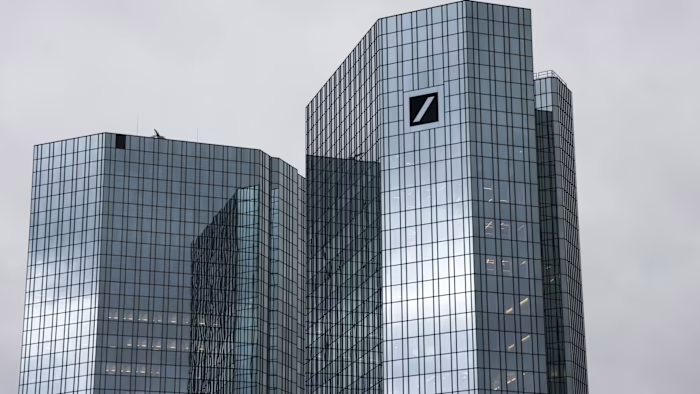
    Deutsche Bank shares have traded above their book value for the first time since the start of the global financial crisis, marking a milestone in the turnaround of Germany’s largest lender after years of legal setbacks, writedowns and restructuring.

    The stock rose to €33.95 in early trading on Monday, climbing above the bank’s most recent reported book value per share of €33.66, a measure of total assets minus liabilities excluding shareholders’ equity.

    Price to book ratio is a key valuation metric for banks, reflecting investor confidence in a lender’s assets, returns and growth outlook. Deutsche had traded at a discount to its book value since early 2008, when doubts about the health of the banking sector were mounting in the early stages of the financial crisis.

    Passing the milestone is a boost for chief executive Christian Sewing, who has vowed to turn the lender into “the European champion in banking”.

    At its lowest point in March 2020, the stock fell below €5, or 0.19 times book value, with investors fearing that the economic downturn caused by the Covid-19 pandemic could derail Sewing’s restructuring plan.

    At the time, Deutsche’s earnings were dragged down by the European Central Bank’s negative interest rates as well as billions of euros in restructuring costs, while its job-cutting plans were hit by delays.

    Investor confidence has slowly returned during a broad three-year rally in European bank shares. Deutsche has resolved long-running legal battles, including relating to mis-selling of mortgage-backed securities, exited lossmaking ventures such as its equities trading division, and increased its focus on fixed-income trading and corporate banking.

    Despite roughly doubling over the past year, the German bank’s shares are still around half their level in early 2008. The bank’s market capitalisation — then about €35bn — has risen to about €65bn, after it raised about €33bn in fresh equity, most recently in 2017, to shore up a balance sheet hit by legal penalties and the costly acquisition of retail lender Postbank.

    Deutsche reported in October its highest nine-month profits since 2007.

    Berlin’s debt-financed investment drive is expected to benefit Deutsche’s investment banking arm as an adviser on sovereign bond issuance and corporate restructuring, according to analysts, while its lending business should profit from rising corporate credit demand.

    Some investors remain cautious. “The recent share price gains simply reflect the move from negligible earnings to average profitability,” said Andreas Thomae, a strategist at Deka, a top-20 shareholder.

    Analysts are confident Deutsche will hit its target of a 10 per cent return on tangible equity — a key profitability measure — when it reports its results for 2025. Its goal of reaching returns of 13 per cent by 2028 still lags those of European peers, which are aiming for up to 22 per cent.

    Deutsche “will never reach the profitability levels of BBVA or Santander”, Thomae said, citing the bank’s capital-consuming investment banking division.

    Despite the recent rally in the bank’s share price, its annualised total return over the past decade still trails the Stoxx600 Banks index as well as rivals such as Italy’s UniCredit and France’s BNP Paribas.

    Deutsche’s performance is also overshadowed by domestic rival Commerzbank, whose price-to-book ratio has rebounded from 0.13 in March 2020 to more than 1.4 in 2025, helped by a potential takeover offer from UniCredit.

    Deutsche’s problems integrating Postbank have weighed on its retail arm, though profitability has improved after branch closures and job cuts. DWS, its asset management arm, continues to face pressure in alternative investments despite inflows into low-margin passive products such as exchange traded funds.

    While DWS is looking for acquisition targets, Sewing has ruled out major deals by the parent group. “When I still have the chance to get significantly better through my own effort, I don’t want to let anything hold me back from that,” he said last year.

    Continue Reading

  • 2026 Legal Trends to Watch | Insight

    2026 Legal Trends to Watch | Insight


    Map the biggest risks and opportunities in 2026 with this series of articles based on insights, commercial and operational trends, as well as shifting regulation. Explore key trends in AI, cybersecurity, employment, trade, tax, M&A and more, and discover practical insights to help take strategic action for a strong start to 2026.

    Continue Reading

  • Macan 4S in Cappadocia: Beyond the Asphalt

    Macan 4S in Cappadocia: Beyond the Asphalt

    It’s just after five o’clock in the morning. While no one knows exactly what’s going to happen in an hour, many people have already gathered on the roads of the Turkish town of Göreme. Bundled up, they sip on their tea, check the battery level of their cell phones, and wait for the sign.

    There’s snow on the ground in Cappadocia, which makes the plans all the more complicated. The thermometer reads minus nine degrees Celsius as light begins to fill the sky above the Central Anatolia region little by little. The volcanic landscape with its mysterious rock formations begins to take shape in a haze along the horizon, offering a preview of an area that, according to an old legend, once served as a playground of the gods.


    Macan 4S, Cappadocia, 2025, Porsche AG


    The light dusting of snow – like a sprinkle of icing sugar – makes the landscape even more magical. Cappadocia is supposedly home to hundreds of thousands of the unusual tuff formations, which magically sprout out of the ground like asparagus spears and are reminiscent of pointed hats and giant mushrooms. 

    Macan 4S, Cappadocia, 2025, Porsche AG


    Macan 4S Electric : Electric power consumption* combined (WLTP) 20.5 – 17.7 kWh/100 km, CO₂ emissions* combined (WLTP) 0 g/km, CO₂ class A

    Researchers agree that it took nature thousands of years to create this work of art. In addition to admiring the rocks, Cappadocians have also carved their homes and even churches into them. The rock formations were added to the UNESCO World Heritage list in 1985.

    The new Porsche Macan 4S will put its off-road capabilities to the test in Cappadocia, which it’s well equipped to do as standard. Both axles are driven by an efficient, powerful electric motor. When Launch Control is activated, the system output is 380 kW (516 PS) with a torque of 820 Nm. To minimize slip to the highest degree possible, the electronics control the interplay of both electric motors almost in real time. In other words, Porsche Traction Management (ePTM) distributes the immense power within ten milliseconds, which is around five times faster than conventional all-wheel drive systems.

    Adventure beyond the asphalt 

    When the Macan 4S’s Matrix Design LED headlights illuminate the first rock formations in Göreme, sunrise is no longer far off.

    Atıl Ulaş Cüce is taking us down narrow tracks that have never seen asphalt. The Cappadocia expert has been guiding tourists through the fascinating landscape in the heart of Türkiye for nearly 30 years, including some Porsche drivers. But none of them have gone as deep into the landscape as we will today, he says. The closer the Macan 4S gets to the mountains, the more demanding the route becomes, gradually deteriorating into ruts and bumps. Atıl’s face betrays his growing concern.

    Atıl Ulaş Cüce, Cappadocia, 2025, Porsche AG


    Atıl Ulaş Cüce: He came to Cappadocia around 30 years ago, fell in love with the region, and has never left. Atıl is now one of the most experienced guides in this extraordinary landscape, which is steeped in history.

    Two taps on the central display – and his smile is back. The activated off-road driving mode controls the all-wheel drive on challenging tracks. A virtual center differential lock limits the differential speed between the front and rear axles, which maximizes traction. The chassis also lifts to off-road height, with an additional 20 millimeters in the first setting.

    Macan 4S, Cappadocia, 2025, Porsche AG


    And if you opt for special terrain, the Macan 4S offers an increase in ground clearance of 40 millimeters. The optional off-road design package offers an approach angle of up to 17.4 degrees at the front of our vehicle. It’s unanimous: these 4×4 options are a game changer. The Macan can now navigate the terrain with confidence and ease. From the front seats, we can see how wild the tracks become, but don’t feel any strain in the chassis or the drive.

    Macan 4S, Cappadocia, 2025, Porsche AG


    Authentic: A rock jungle and Vesuvius Grey 21-inch wheels in off-road look on the outside, and high comfort with lots of leather and three perfectly framed screens on the inside.

    Atıl’s cell phone rings, which is the sign we’ve been waiting for: the hot-air balloons will fly at sunrise. The atmosphere changes instantly in the playground of the gods. We park the Macan 4S on a hill and watch as the valley fills with buses big and small. Among them, there are old off-road vehicles towing balloon baskets on long trailers. And then pink American convertibles from the 1970s maneuver into position. Their drivers have brought changing rooms made of tent material. Balloon trips are now the top tourist attraction in Cappadocia. When they start, it’s about so much more than just extraordinary views. It’s also about creating the perfect picture.

    One Porsche and a hundred balloons

    A short time later, the first 20 balloons lift off. The flames of their burners illuminate the envelopes, together creating an absolutely breathtaking postcard image. Colorful balloons float over a valley full of bizarre rock formations as the sun rises. What sounds kitschy is actually kind of magical. And in the center of it all – the new Macan 4S in Oak Green Metallic – like an object from the future. “It’s like nothing else, isn’t it?” asks Atıl, his eyes sparkling. Even after his many years in Cappadocia, he’s never grown tired of this sight. And we can understand why.

    The spectacle continues for about an hour. Around a hundred of the 170 hot-air balloons with an official permit are floating around us today. This number not only seems gigantic, it actually is. You could compare it with a bee colony scouring a single shrub for nectar all at once.  

    Macan 4S, Cappadocia, 2025, Porsche AG


    Sunrise in Cappadocia: The fully electric two-component sunroof with roller shade is lightly tinted and provides sweeping views.

    We follow one of the colorful balloons to its landing location. The route takes us through the rocky landscape – the tall, narrow rocks standing there like silent observers, the guardians of Cappadocia. 

    “Before the balloons began flying, I would take tourists hiking here,” says Atıl, showing the way. “There are some people who still hike, and others who only come for the balloons. The times are changing, and balloons are now the main attraction.”

    Çağlar Aksoylu lands the basket of his balloon directly on the trailer to the cheering and applause of the 18 passengers. Çağlar, sporting a pair of reflective sunglasses, responds with a wide grin. The 35-year-old former basketball player has been a professional balloon pilot for four years. “I even help develop the balloons, baskets, and burners. We produce them here in the area,” he explains proudly. What does he like most about his job? “I can float on a cloud every day.”

    Çağlar Aksoylu, Cappadocia, 2025, Porsche AG


    Çağlar Aksoylu: He pilots one of the 170 hot-air balloons permitted to lift off over Cappadocia. For Çağlar, it feels like floating on a cloud every morning. In addition to flying, he also helps develop balloons, burners, and baskets.

    News of the attraction seems to have spread far and wide around the world, accelerating local demand. How did it all start? “A German tour operator came up with the idea of flying a hot-air balloon over Cappadocia in the early 1990s,” explains Atıl. When the contract expired, the balloon pilot stuck around and continued offering flights. The services available expanded over the years to keep up with the interest. Social media ultimately fueled demand like a turbo engine.

    Macan 4S, Cappadocia, 2025, Porsche AG


    Light on its feet: Thanks to intelligent all-wheel drive and up to 820 Nm of torque, the Macan 4S can maneuver through the unique rocky landscape with ease.

    Located in the village of Ayvali some 20 minutes away, the Green Garden restaurant seems like the polar opposite of this development.

    Güler Gürbüz, Cappadocia, 2025, Porsche AG


    Güler Gürbüz: She has been cooking traditional Cappadocian fare for her guests for many years. Her charming restaurant called Green Garden features a rare, enchanting outdoor oven made from terra-cotta.

    The Macan 4S flaunts its softer side on the road, offering a quiet and highly comfortable drive, thanks in large part to the successful suspension management (PASM). With its two-valve technology, PASM can control the rebound and compression stages separately – and thus switch from performance to comfort in the blink of an eye. Or the other way around. Available in the Macan for the first time, rear-axle steering offers a steering angle of up to five degrees – yet another comfort highlight. 

    With 15 percent more direct steering ratio at the front axle, the increase in agility is most noticeable in dynamic performance. But rear steering can also help in city traffic and maneuvering, with the rear wheels turning in the opposite direction of the front wheels at speeds of up to around 80 kmh. 

    Güler Gürbüz is beaming from ear to ear as we enter her Green Garden restaurant, where she cooks traditional cuisine. Her most important tool is a special outdoor oven clad in terra-cotta, with which she prepares extremely tender meat dishes. Atıl tells us there are only two ovens like it remaining in the region.

    After the meal, Atıl takes us out to see a stunning gorge. A steep track wide enough just for us leads downward. There’s a phone number written on the striking rock walls. “That’s the towing service, in case anyone in a rental car gets stuck. It happens often enough,” explains the guide. The Macan 4S handles the track with ease – on the way down and then back up again.

    Regional delicacy, Cappadocia, 2025, Porsche AG


    Regional delicacy: Lamb delicately cooked in a clay pot with vegetables and garlic.

    Stress-free charging

    We take a leisurely drive back to Göreme at the end of the day. All the excitement of the morning has dissipated, and the tourists are all happily seated in the many restaurants. The Macan pulls up to one of the few charging stations in the small town. The high-voltage battery with 100 kWh of gross energy content is at around 45 percent. Thanks to the 800-volt system, the SUV battery could theoretically charge from 10 to 80 percent in just 21 minutes* if a CCS fast charging station were available. Here in Göreme, it’s 10.9 kW. But that’s not an issue, as we’re not going anywhere else today and can simply charge overnight.

    Macan 4S, Cappadocia, 2025, Porsche AG


    Our last appointment for the day is a three-minute walk up the mountain to the hotel that Zehra Daşdeler took over from her father. Nestled in a picturesque landscape, Amber Cave Suites is not just any hotel, as its rooms are built inside fairy chimneys – the tall, narrow rock formations the Cappadocians once carved their homes into. Guests have the opportunity to sleep in a cozy cave, without having to give up any of the amenities of a good hotel. Zehra operates the hotel with lots of love, creating an ambience that’s as tasteful as it is extraordinary.

    Zehra and Hasan Daşdeler, Cappadocia, 2025, Porsche AG


    Zehra and Hasan Daşdeler: Zehra took over Amber Cave Suites from her father, Hasan. An extraordinary hotel with rooms built inside fairy chimneys, as the Cappadocian rock caves are referred to.

    When she was growing up here, life and tourism were not quite so fast-paced. “Back then, people came for one or two weeks. Now they stay for a night or two. Some are only interested in taking a few photos for Instagram. But that, too, will change again.”

    Amber Cave Suites, Cappadocia, 2025, Porsche AG


    Magical: The view from the breakfast table at Amber Cave Suites, a hotel carved into rock in the town of Göreme.

    Her words echo as we embark on our journey of discovery at the next sunrise. With the Macan 4S’s battery full and the off-road program activated, we set off at a leisurely pace and let the day unfold. 

    Atıl takes us to a climbing trail for cars, where the sun appears to jump back and forth between the rocks as it rises. That’s the magic of Cappadocia – a playground of the gods.

    Info

    Text first published in the Porsche magazine Christophorus 415.

    Text: Dani Heyne
    Images: Philipp Rupprecht

    Copyright: All images, videos and audio files published in this article are subject to copyright. Reproduction in whole or in part is not permitted without the written consent of Dr. Ing. h.c. F. Porsche AG. Please contact newsroom@porsche.com for further information.

    Continue Reading

  • Divorce Delays: The later-life splits pushing more than 200,000 people to delay retirement – Legal & General Group

    1. Divorce Delays: The later-life splits pushing more than 200,000 people to delay retirement  Legal & General Group
    2. Divorcing after 50? There’s a special financial adviser for that  The Straits Times
    3. Later-life divorces alter long-term financial plans for many over-50s, L&G research finds  The Intermediary

    Continue Reading

  • Collapse of ‘zombie’ UK firms forecast to fuel unemployment in 2026 | Unemployment

    Collapse of ‘zombie’ UK firms forecast to fuel unemployment in 2026 | Unemployment

    The UK is poised for a rise in unemployment in 2026 fuelled by the collapse of “zombie” companies that have struggled to adapt to a rise in business costs, according to a report.

    At the start of what could be a pivotal year for the economy, the Resolution Foundation said businesses were grappling with a “triple whammy” of multiyear increases in interest rates, energy prices and the minimum wage that could “finish off” some underperforming companies.

    Publishing its new year outlook report, the thinktank said 2026 had potential to be a “turning point” after decades of sluggish productivity growth – a key metric of output per hour of work which is vital for raising living standards.

    However, it warned this could involve a sharp rise in unemployment as more unproductive companies go bust.

    Ruth Curtice, chief executive of the Resolution Foundation, said there were indications 2026 could be remembered as a “turning point year” by future economists and demographers.

    “There are early and encouraging signs of a mild zombie apocalypse, where higher interest rates and minimum wages have combined to kill off struggling firms and leave the door open for new, more productive ones to replace them,” she said.

    “But while this is good news for our medium-term economic prospects, the short-term impact could be job displacement and higher unemployment. Policymakers will need to redouble efforts to address this problem.”

    Unemployment in the UK has reached the highest level outside the Covid pandemic in a decade, with the headline rate hitting 5.1% in October as employers held back on hiring before Rachel Reeves’s autumn budget.

    Business leaders have said tax increases and a rising living wage are among contributing factors deterring employers from taking on staff.

    Experts have warned for several years that Britain has been held back by so-called “zombie firms” – companies which barely make enough money to cover their costs but just about stay in business – preventing the allocation of resources to more productive sectors of the economy.

    Economists have suggested that low interest rates in the years since the 2008 financial crisis contributed to this, as cheap borrowing costs helped debt-laden companies to stay afloat.

    Businesses have come under pressure from 14 consecutive Bank of England rate increases between December 2021 and August 2023, designed to tackle inflation. While the Bank has since cut the base rate six times – from a peak of 5.25% to 3.75% – firms’ operating costs remain higher than before the Covid pandemic.

    In a sign of the pressure, the British Chambers of Commerce (BCC) warned in a separate report that business confidence slumped to the lowest level in three years in the final quarter of 2025.

    In a survey of more than 4,600 firms carried out between 10 November and 8 December – straddling Reeves’s 26 November budget – the lobby group found that tax was the biggest business concern, followed by inflation.

    Fewer than half (46%) of companies said they expected increased turnover over the next 12 months, while nearly a quarter (24%) expected a decrease. Only 19% had increased investment and 27% had scaled back plans.

    David Bharier, head of research at the BCC, said: “Our data shows more clouds have gathered over business confidence, and the outlook for SMEs in 2026 is unsettled.”

    The Resolution Foundation said there were early signs that Britain’s productivity growth was being boosted by “creative destruction”, whereby newer and better firms, products or processes replace older, less-efficient, ones. Adoption of artificial intelligence technologies could also be playing a role, it said.

    However, it said the short-term impact from job losses would be “hugely difficult,” and urged the government to focus on supporting living standards.

    “Amidst this change one thing that isn’t changing enough is disposable income growth, which is set to grow at mediocre rates for the rest of the parliament,” Curtice said.

    “We must hope – but more importantly act – to ensure that 2026 is a turning point year for lifting living standards too.”

    Continue Reading

  • This Vietnamese town boomed as factories left China. Now it’s asking what’s next?

    This Vietnamese town boomed as factories left China. Now it’s asking what’s next?

    BAC NINH, Vietnam — The transformation of Vietnam’s Bac Ninh is evident in the signs above its shops and the spicy Chinese and Korean dishes on its tables.

    Once known for its rice fields and the love duets of its centuries-old Quan Ho folk songs, the city just north of Hanoi has become one of Vietnam’s busiest factory zones, reflecting a surge of investment, hastened by President Donald Trump’s tariff hikes, that are reshaping the region.

    The economy has profited from friction between Washington and Beijing as factories shifted out of China, joining earlier waves of foreign investment by the Japanese and South Koreans that have made Vietnam a global manufacturing hub. But rising labor costs, worker shortages and inadequate infrastructure are exposing the limits to its rapid rise.

    With rivals like Indonesia and the Philippines competing hard for new projects, Vietnam is trying to climb into higher-value manufacturing and expand export markets to maintain that momentum. That effort is evident in Bac Ninh.

    Traditionally a center for artisans, Bac Ninh’s first boom began around 2008 when Samsung built its first phone factory there, turning Vietnam into its largest offshore manufacturing base.

    Now, Chinese companies are pouring in as they diversify their factory locations to skirt U.S. tariffs and other trade restrictions. After Hanoi and Beijing normalized ties in the 1990s, inflows of Chinese investment began to pick up as Chinese firms in places like Bac Ninh tapped Vietnam’s electronics supply chain, labor force and supportive local governments, often aided by Chinese-speaking intermediaries who smooth paperwork and logistics.

    But Vietnam is too small to replace China, whose economy is 40 times larger, as the world’s factory floor. To try to keep up, its leaders are building new infrastructure, including a highway to the Chinese border that has cut travel time by more than an hour. A railway will connect Hanoi to Haiphong — Vietnam’s largest seaport — and then the border town of Lao Cai.

    On Dec. 19, Bac Ninh broke ground on the expansion of an industrial zone for high-tech manufacturing, including electronics, pharmaceuticals and clean energy. It’s part of a synchronized nationwide push in which Vietnam launched 234 major projects worth more than $129 billion just weeks before a pivotal National Party Congress in January, when leaders will decide the country’s political leadership and economic direction.

    In Bac Ninh’s downtown, a convenience store bears the name Tmall, after Alibaba’s flagship online marketplace. Signs in Chinese advertise services for investors. Chinese–Vietnamese language schools have opened to help locals and Chinese to learn each others’ languages.

    But as Chinese companies compete for the best labor and other resources, costs are rising for the “China plus one” strategy of moving factories out of China to other locations, for example, Apple’s shift into India.

    “It is becoming difficult to recruit workers,” said Peng, who works at a telecoms equipment company that moved from China’s southern technology hub of Shenzhen. He gave only one name because he was not authorized to speak to the media.

    Labor costs have jumped 10%–15% since 2024, he said, “And we expect them to keep rising.”

    Vietnam still need technology, equipment and expertise from China, which had created “the best manufacturing ecosystem,” said Jacob Rothman, co-founder and CEO of China-based Velong Enterprises, which makes grill tools and kitchen gadgets and has shifted some production to Southeast Asian countries including Cambodia and Vietnam.

    Supply chains and manufacturers in China have benefited from decades of government support, large-scale investment and its huge population, Rothman said. “You can’t recreate that overnight.”

    Brian Bourke, global chief commercial officer at U.S.-based SEKO Logistics, said while factories making footwear, furniture and technology are still relocating to Vietnam, it lags China in infrastructure and logistics capabilities.

    Some of those limits are surfacing in boomtowns like Bac Ninh, where firms are trying to lure workers with higher wages and bonuses, a box of instant noodles on their first day and bus fares if they commute from another city, according to state media.

    Few countries have benefitted more from Trump’s trade war than Vietnam, whose biggest export market is still the U.S. In 2024, Vietnam ran a $123.5 billion surplus with the U.S., the third largest behind China and Mexico. That irked Trump, who threatened a 46% import tax on Vietnamese goods before settling on 20%.

    The two countries are still working toward a deal to keep most tariffs at 20%. Vietnam has offered broad preferential access for U.S. products, the White House said in October. So far, it has largely absorbed the tariffs, running a trade surplus of $121.6 billion in January-November 2025.

    The agreement in October by Trump and Chinese leader Xi Jinping to a year-long trade truce and lower average tariffs on Chinese exports to the U.S. to about 47% helped ease some concerns. But persisting uncertainty over tariffs and other trade restrictions means companies aren’t just trying to shift factories out of China but to spread them across several countries, said Frederic Neumann, chief Asia economist at HSBC.

    Even with lower U.S. tariffs on China, the calculus still favors moving to Southeast Asia where manufacturing inefficiencies add only about 10% in cost. But while large corporations can shift production easily, smaller firms may struggle to fit a new factory with expensive equipment.

    “(The) race to move outside of China is still happening, and it’s accelerating,” Rothman said.

    Vietnam is still attracting ample foreign investment. Cumulative foreign investment topped $28.5 billion as of September, up 15% from last year. But scrutiny of Vietnam’s role as a hub for tariff-dodging transshipments has some manufacturers hedging their bets.

    One of SEKO Logistics’ customers has shifted some of its furniture making to India, not wanting to “put all their eggs in Vietnam,” Bourke said.

    Countries like Indonesia and the Philippines, which missed the early gains Vietnam captured, are promoting themselves as alternative manufacturing bases. In the Philippines, a new law allows foreign investors to lease private land for up to 99 years to attract long-term commercial and industrial investment.

    Vietnam has a goal of becoming rich by 2045. It aims to become Asia’s next “tiger economy,” following export powerhouses like South Korea and Taiwan by shifting from low-cost assembly work to manufacture higher-value products like electronics and clean energy equipment.

    It’s offering incentives like tax breaks on imported machinery and discounted rents to help factory suppliers upgrade and modernize. About a third still use non-automated equipment and only about 10% use robots on their production lines.

    The country also is trying to reduce its dependence on the U.S. market by expanding exports to the Middle East, Latin America, Africa and India. Overseas trade offices have been asked to share market intelligence and promote products made in Vietnam.

    Vietnam knows that rising costs and tougher competition will test how far it — and places like Bac Ninh — can climb. Announcing hundreds of projects in December, Prime Minister Pham Minh Chinh framed the stakes: Vietnam must “reach far into the ocean, delve deep underground and soar high into space.”

    ___

    Chan reported from Hong Kong. Associated Press researcher Yu Bing in Beijing contributed.

    ___

    The Associated Press’ climate and environmental coverage receives financial support from multiple private foundations. The AP is solely responsible for all content. Find AP’s standards for working with philanthropies, a list of supporters and funded coverage areas at AP.org.

    Continue Reading

  • FTSE 100 to rise after US capture of Maduro

    (Alliance News) – Stocks in London are set to open higher on Monday, with geopolitical developments in focus in the wake of US intervention in Venezuela over the weekend.

    IG says futures indicate the FTSE 100 to open up 55.4 points, or 0.6%, at 10,006.54 on Monday. The index of London large-caps closed up 19.76 points, 0.2%, at 9,951.14 on Friday. It had earlier traded as high as 10,046.25, a record intra-day level.

    Sterling was at USD1.3434 on Monday morning, down from USD1.3491 at the London equities close on Friday. The euro was lower at USD1.1690 from USD1.1745. Against the yen, the dollar was higher at JPY157.06 versus JPY156.64.

    Geopolitical factors will be in focus on Monday after dramatic events in Venezuela over the weekend.

    Venezuelan President Nicolas Maduro was in a New York jail on Saturday, hours after US special forces seized and flew him out of his country — which US President Donald Trump said would come under effective US control.

    Trump said he was “designating people” from his cabinet to be in charge in Venezuela but gave no further details. In another surprise, Trump indicated US troops could be deployed, saying Washington is “not afraid of boots on the ground”.

    Venezuela’s new leadership has signalled a willingness to cooperate with the US.

    “Wene invite the US government to collaborate with us on an agenda of cooperation oriented towards shared development within the framework of international law to strengthen lasting community coexistce,” Delcy Rodriguez, declared the interim president of Venezuela, said on Sunday in a statement posted on Instagram.

    Gold was up at USD4,421.60 an ounce early on Monday from USD4,320.16 late Friday. Brent oil was trading slightly higher at USD60.32 a barrel from USD60.09.

    Meanwhile, Trump doubled down on his claim that Greenland should become part of the US, despite calls by Denmark’s prime minister to stop “threatening” the territory.

    “We need Greenland from the standpoint of national security, and Denmark is not going to be able to do it,” Trump said while aboard Air Force One on Sunday.

    In the US on Friday, Wall Street ended mostly higher, with the Dow Jones Industrial Average up 0.7%, while the S&P 500 climbed 0.2% and the Nasdaq Composite ended marginally lower.

    The yield on the 10-year US Treasury was at 4.18% on Monday, slimmed from 4.19% on Friday. The yield on the 30-year was at 4.86%, slightly narrowed from 4.87%.

    In Asia on Monday, the Nikkei 225 in Tokyo was up 3.0%. In China, the Shanghai Composite was 1.3% higher, while the Hang Seng Index in Hong Kong gained 0.1%. The S&P/ASX 200 in Sydney rose slightly.

    There are no local corporate events scheduled for Monday.

    Monday’s global economic calendar has UK mortgage approvals data and the US ISM manufacturing PMI.

    By Michael Hennessey, Alliance News reporter

    Comments and questions to newsroom@alliancenews.com

    Copyright 2026 Alliance News Ltd. All Rights Reserved.

    Continue Reading

  • Capricorn | Operational and Financial Update

    Capricorn is pleased to provide the following operational and financial update.

    Operational update

    Capricorn’s working interest production averaged 20,175 boepd (41% liquids) in 2025, above the production guidance midpoint of 19,000 boepd. The 2025 exit rate was 21,003 boepd with recent strong production performance driven by new development wells drilled since July 2025 and a waterflood programme in the Badr El Din (BED) field area. Notably, gas performance since October has been enhanced by the drilling of BED15-31 which has produced strongly from the Lower Bahariya formation and offers the potential for follow-up wells that will be prioritised in early 2026.

    Exploration drilling in 2025 produced encouraging results in the North Um Baraka (NUMB) and South East Horus (SEH) licences where Capricorn is working with the Operator to evaluate future activity. In NUMB, the joint venture is progressing a development lease application following the drilling of NUMB-6. This well should be tied-in early 2026 with follow-up drilling anticipated in 2027. In SEH, the SEH-6X well established the extension of an active petroleum system and was considered sufficiently positive to justify progressing to phase 2 on the licence.

    Financial update

    The Company received $43m from the Egyptian General Petroleum Corporation (EGPC) in late December. This brings the total amount received by Capricorn since 30 June 2025 to $156m, reducing its accounts receivable to the lowest position since 2022, at approximately $84m (H1/25: $182m), excluding expected credit loss adjustments.

    Capricorn has repaid its entire outstanding Senior Debt Facility with a voluntary payment of $18m prior to the end of the year. Additionally, the Junior Debt Facility amortised by $10m in Q4 2025, leaving an outstanding debt balance of $30m on 31 December 2025. The remaining balance is currently scheduled for settlement in two instalments during 2026 and 2027. At 31 December 2025, the Company’s net cash position stood at approximately $103m (H1/25: $32m).

    Capricorn announced in December that it had entered into a lock-up agreement to support Harbour Energy Plc’s (Harbour’s) acquisition of the Waldorf Production group and will settle its unsecured claims against Waldorf for a payment estimated to be around $4-5m, based on a methodology agreed between Capricorn and certain of Waldorf’s creditors. Completion of the acquisition is subject to regulatory consents and is likely to require the sanction of a further restructuring plan.

    Outlook

    Last month, the Egyptian Cabinet approved the integrated concession agreement, representing the final step prior to parliamentary approval and formal ratification expected in Q1 2026. The Company is committed to leveraging the new terms to enhance production and reserves.

    * Reported production volumes and financial figures are unaudited and subject to change

    DOWNLOAD PDF

    Enquiries to:

    Analysts / Investors
    Nathan Piper, Commercial Director
    Tel: 0131 475 3000

    Media
    Diana Milford, Corporate Affairs
    Tel: 0131 475 3000

    Georgia Edmonds / Violet Wilson / Fergus Young, Camarco
    Tel: 0203 757 4980

    Capricorn Energy

    Capricorn is an Egypt-focused energy producer, with an attractive portfolio of onshore exploration, development and production assets in the Western Desert. For more information on Capricorn visit: https://www.capricornenergy.com

    Continue Reading

  • Balfour Beatty completes disposal of ten Infrastructure Investments assets

    Balfour Beatty completes disposal of ten Infrastructure Investments assets

    Balfour Beatty, the international infrastructure group, today announces the sale of ten UK assets from its Infrastructure Investments portfolio. In December 2025, the Group sold its share in each of the assets to Equitix for combined proceeds of £87 million, with a total gain on the disposals of £7 million.

    The disposed assets comprise three Offshore Transmission Owners (OFTOs), five street lighting projects, one biomass plant and one road concession.

    The combined proceeds are in excess of the Balfour Beatty Directors’ valuation as of 27 June 2025, consistent with the Group’s strategy of optimising value through the disposal of operational assets, whilst continuing to invest in new asset opportunities.

    ENDS

    Analyst/investor enquiries:
    Jim Ryan
    Tel. +44 (0)785 836 8527
    jim.ryan@balfourbeatty.com 

    Media enquiries:             
    Vivienne Dunn
    Tel. +44 (0)203 810 2345
    vivienne.dunn@balfourbeatty.com

    Notes to editors:

    • Balfour Beatty is a leading international infrastructure group with 27,000 employees driving the delivery of powerful new solutions, shaping thinking, creating skylines and inspiring a new generation of talent to be the change-makers of tomorrow.
    • We finance, develop, build, maintain and operate the increasingly complex and critical infrastructure that supports national economies and deliver projects at the heart of local communities.
    • For over 100 years, we have created iconic buildings and infrastructure all over the world. Currently, we are working to deliver Hinkley Point C, the first UK nuclear power station in a generation; constructing the world-class arts and cultural facility, the Lyric Theatre, in Hong Kong; and designing, building, financing, operating and maintaining the Automated People Mover superstructure at the fifth busiest airport in the world, Los Angeles International Airport.
    • Balfour Beatty Investments is an international infrastructure investor operating in the UK and US. We provide the investment capability required to deliver complex infrastructure projects. As one of the largest investors in the Public Private Partnership industry, we have built a portfolio across a range of markets including student accommodation, the private rental sector housing and multi-family housing.

    Continue Reading